The Hapalua!
Over 340 transactions have been documented since 1994.
Other interesting Hawaii coin auction stats at:
http://www.ngccoin.com/auctioncentral/SubCategory.aspx?SubCatID=82&PopSubCat=us-hawaii
The Hapalua!
Over 340 transactions have been documented since 1994.
Other interesting Hawaii coin auction stats at:
http://www.ngccoin.com/auctioncentral/SubCategory.aspx?SubCatID=82&PopSubCat=us-hawaii
A few ebay sellers need to perform research on what they are selling. So…what does this token has to do with Hawaii?
The answer: Nothing
Hawaiian Money Standard Catalog 2nd Edition by Medcalf and Russell, page 100, states that about 30 bronze “production sets” were made for display purposes. My research indicates these sets were used for promotional purposes. This required the medals to be housed in a plaque for portability and ease for re-display from event to event. The set is in my collection retains its original display plaque.
In census comparison with the official Hawaii Statehood medal in gold (50), the process set is rarer (30).

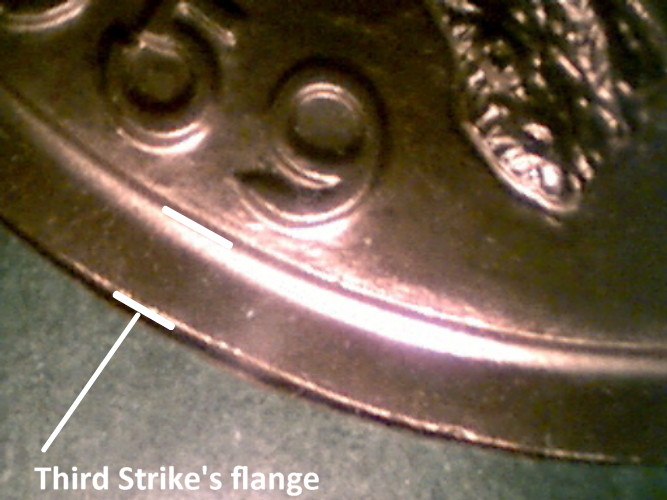
The process set “flange” is a common trait for medals struck without a collar. As each strike occurs he flange grows longer. After the final strike, the flange is removed by grinding (if you look at a completed medal you might see a few grinding marks.
Images are from my process set.


Mintage confusion of this coin was started by the Royal Hawaiian Mint.
What is its mintage?
RHM database indicates a mintage of 142. On the COA (rear inside cover of booklet) states a maximum mintage of 1000. A number is also handwritten identifying its strike sequence. An example is 467 of 1000.
RHM never had a large production run for an individually issued gold coins. Production run of gold coin in sets never exceed 950 . Besides it makes good business sense to be flexible with minting coin. That is, have advance printing of the COA with estimated mintage and strike the coin based on demand not to exceed the maximum mintage. My best guess demand was not there.
I have ignored the COA mintage number and have been using 142 mintage number from the RHM database.

It took me a few days to locate a gold specimen to compare with.
When I purchased my bronze specimen. I knew the reverse was correct die for the Hawaiian Mint 18K 21mm gold. It was the obverse that was puzzling.
After taking a few pictures of my specimen and locating an actual gold specimen, it can be confirmed that I have a bronze trial piece. As for the the claim that my bronze trial piece is one of five, it maybe true, its not confirmed that there were only 5 struck.
In the image, directly compare Kalakaua’s hair strands. They are exactly placed. Click image to isolate the image, then click again to enlarge.
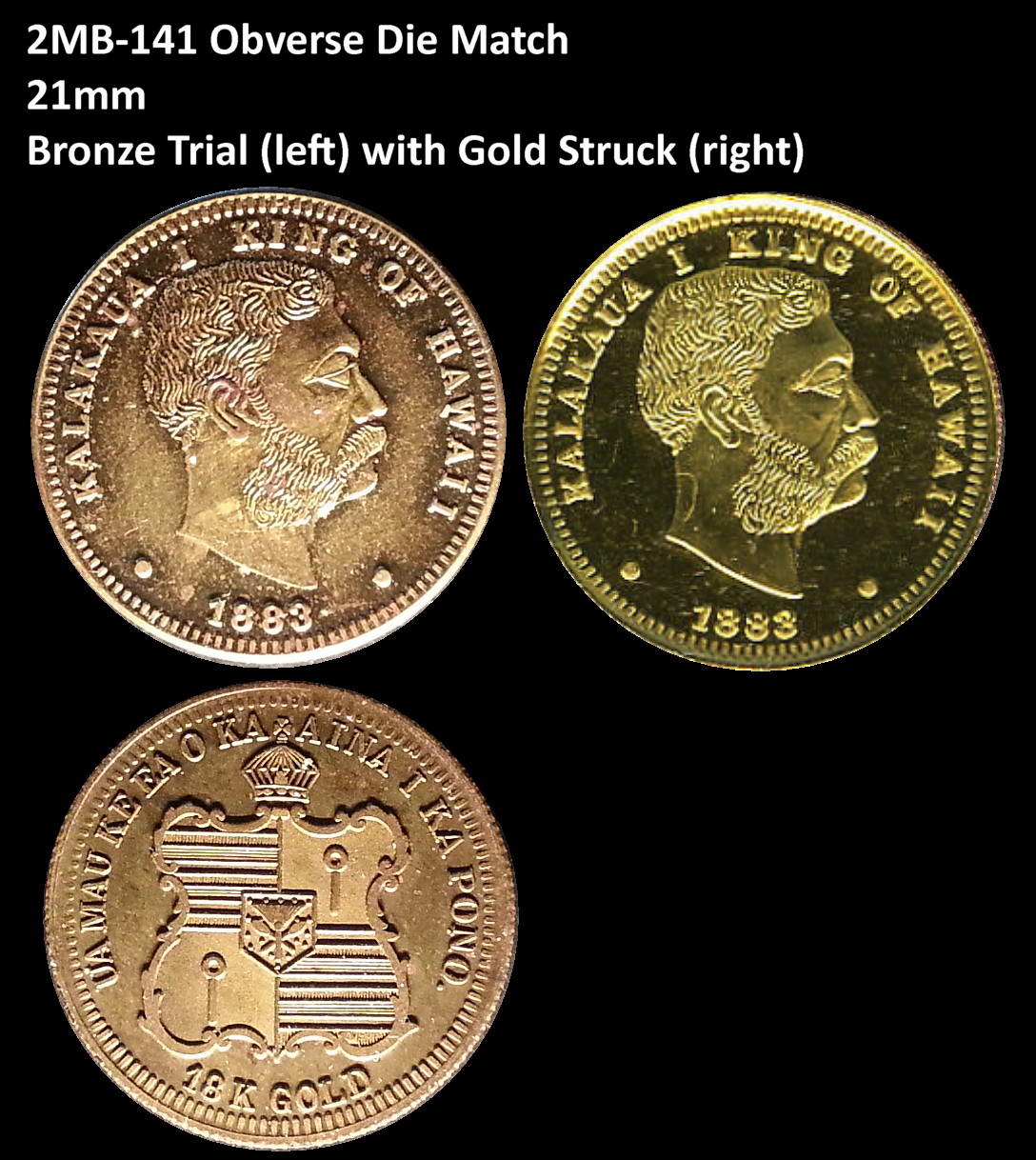
M&R indicates that 2M-141 had 50 gold specimens struck.
RHM database indicates only 26 gold specimens were struck (listed as 1982 Kalakaua 21 mm 18K Gold).
There is no public record that any bronze specimens were struck. Coin holder from seller indicates only 5 were struck.
Similar design elements with the Royal Hawaiian Mint issued 2M-205.
Minter is unknown. This may be a ‘Iolani Palace souvenir piece.
On the reverse: Taro leaves increased to 11, added Kalakaua birth year and year of death, and added Kalakaua’s motto “Ho’oulu Lahui”.
No minter’s hallmark, metal identifier, or metal fineness. However the weight is 1/2 oz and metal looks silver. The 3mm thickness is also a hint that its a silver bullion coin.

I received my HK-535/2MS-13 today.
It took a total of 18-days after I placed a hold for purchase order with an “old school dealer”. I’m pleasantly happy with the coin considering it was purchases sight unseen (dealer has good eye with grading).

Got out my old electronic microscope/Windows XP laptop and took a few pictures.
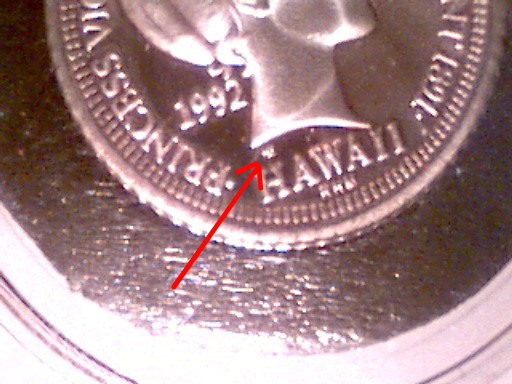

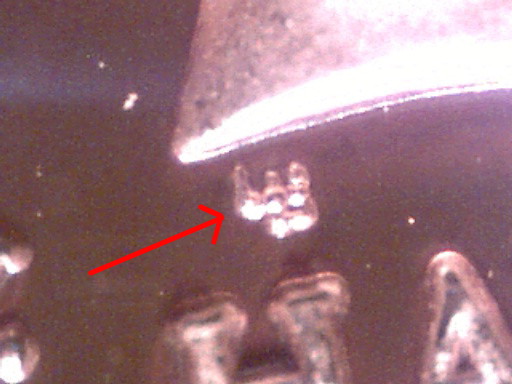

What I first believe was an L and E now looks like a W over a lower case b


Back in 2010 I donated a piece of Hawaiian history to ‘Iolani Palace. They did not have a specimen in their collection. After the donation was made they put my wife’s and my name on a 2010 donors plaque that resides in the palace today.
An article I wrote and was published in the newsletter of Hawaii State Society of Washington DC. Click to enlarge.
Here is the donation acknowledgement. Click to enlarge.

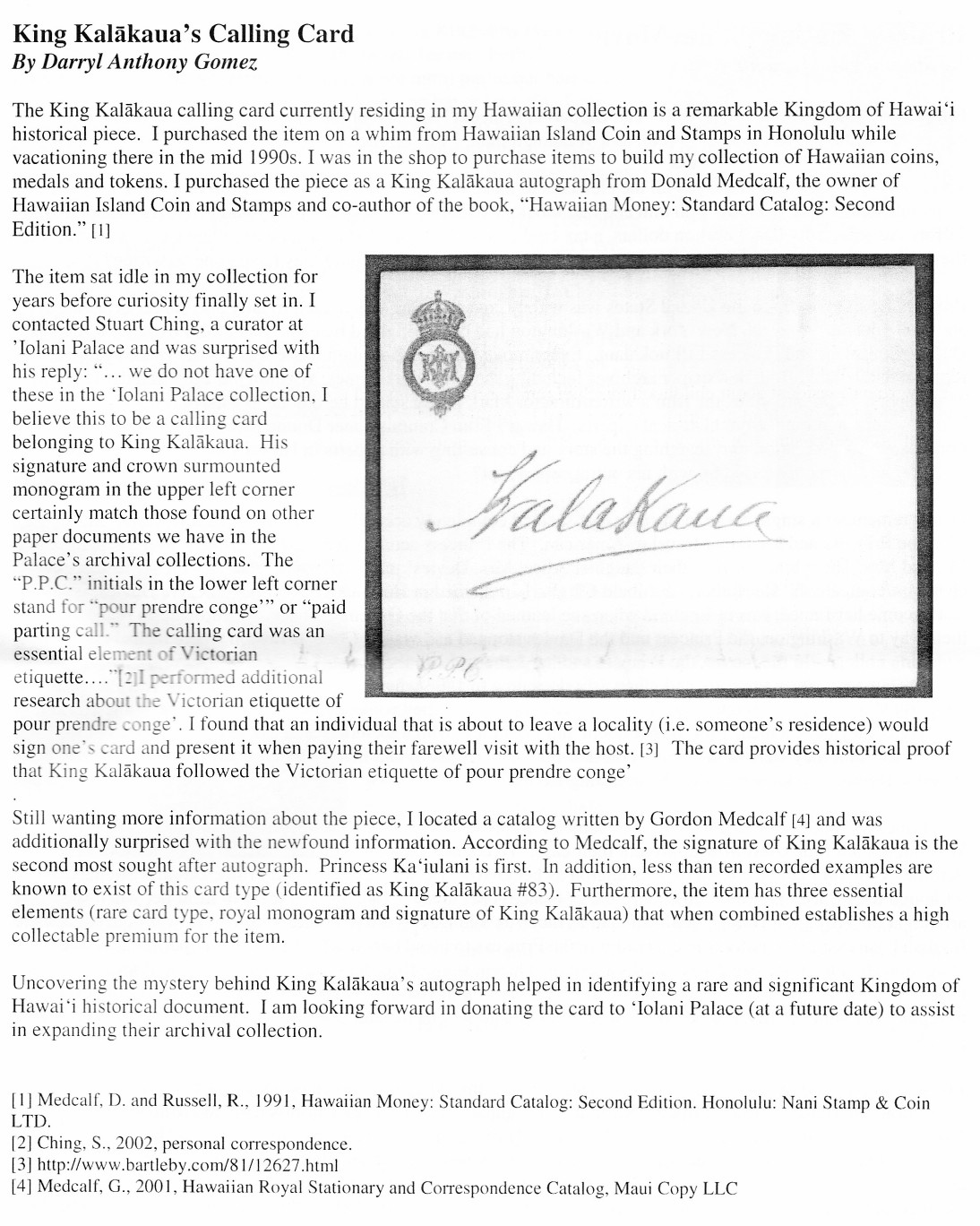
This is the actual Kalakaua calling card that was donated. Click to enlarge.

This ingot is in perfect condition. However, the packaging has extensive creases. The package is sealed. A price sticker is still attached and redacted in black.
This ingot depicts Hawaii state bird and flower. It measures 1.5 inches by 2.1 inches. It weighs 1.25 troy ounces. This ingot was produced and distributed by the Franklin Mint from 1974 through 1978 for each of the 50 states. These dates are prior to M&R 2nd edition catalog (1991) making, therefore it was simply missed for inclusion into the 1991 edition. At my count, there are 91 Franklin Mint issues and M&R did not list all of them. My book will provide a comprehensive list of all the items not listed in M&R and provides more detailed information of the ones that are listed.
Mintage is 2,988 50-piece National Governors’ Conference State ingot sets. Again, I have to emphasize that Franklin Mint issues with Hawaii ties are from broken sets. These sets are broken up for the medal content and individual pieces sold. Patience is required in collecting Franklin Mint issues as specimens appear at irregular intervals.


 The Hawaiiana Numismatist ™
You must be logged in to post a comment.