Alapi’i Collecting

Alapi’i collecting is the special term I use in collecting a specific type of Hawaiiana numismatic material.

The Alapi’i Collector.

The English translation for the Hawaiian word alapi’i is “step”. In this type of collecting, the collector collects by steps.  In alapi’i collecting, the exact numismatic design is collected with three possible steps in mind:

1)      Metal composition step

2)      Diameter size step

3)      Finish step

As an example, a collector acquires an available specimen with the exact same design, but in different metal compositions and sizes. An example is the Hawaiiana numismatist that collects a particular Hawaii Statehood medal design that was struck on a planchet in sizes of 39mm, 32mm, 13mm, and in a variety of metal compositions such as sterling silver, 24KT gold on sterling silver, bronze, and platinum.

Here is an example  alapi’i set.

alohastate

The goal of alapi’i collecting is to secure a design specimen in  a combination of steps or all available the steps. The Franklin Mint issues have an abundance of Hawaiiana related items that fall into the category of alapi’i collecting.

The first difficulty of the alapi’i collecting is the availability of the individual steps. In order to acquire an alapi’i specimen, a completed set must be either broken-up with the individual specimens made available for sale or an entire set purchased and cannibalized for the desired specimen(s) with unwanted pieces dispersed for re-sale.  This is where the term collecting takes heart. One must be patient and diligent to locate the step specimen for sale. One must be on constant watch to locate a particular step specimen, as sets are broken up at irregular intervals.

The second difficulty in alapi’i collecting is the limited number of available Franklin Mint sets. Several of the Franklin Mint sets are limited issued and fall in the category of single or double digit mintages. The Hawaiiana Numismatist is also competing with the Franklin Mint set collectors for these limited sets. And in most cases the only means to acquire a step specimen is by direct cannibalization of a completed set. This can be cost prohibitive as most completed sets command a premium.

The third and  final alapi’i collecting difficulty is the incomplete and inaccuracies in current Hawaiian numismatic reference books. Hopefully, the book  I am in the process of writing will start the trend in  alapi’i collecting  and assist Hawaiiana numismatists with a more comprehensive and accurate listing of the Franklin Mint issues.

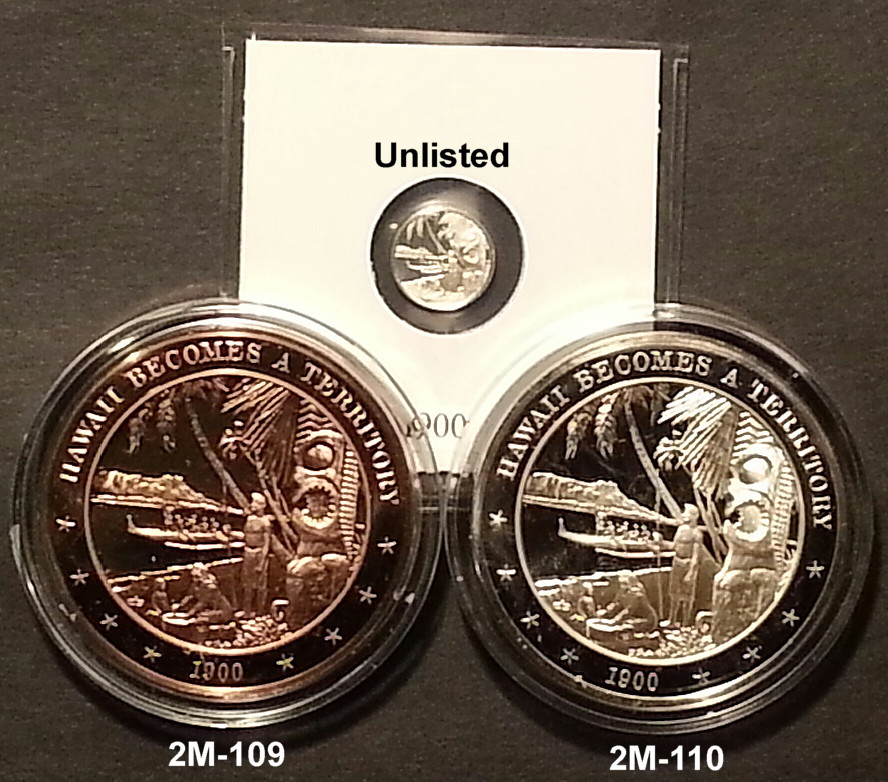
Here is another  alapi’i set with a unlisted step. (An example of  inaccuracies in the 1991 Medcalf & Russell book).
seta

The Great Seal of the Hawaiian Islands

Did you know that there was a modern replica of the Great Seal of the Hawaiian Islands?

First let’s scan a few newspapers from the past.

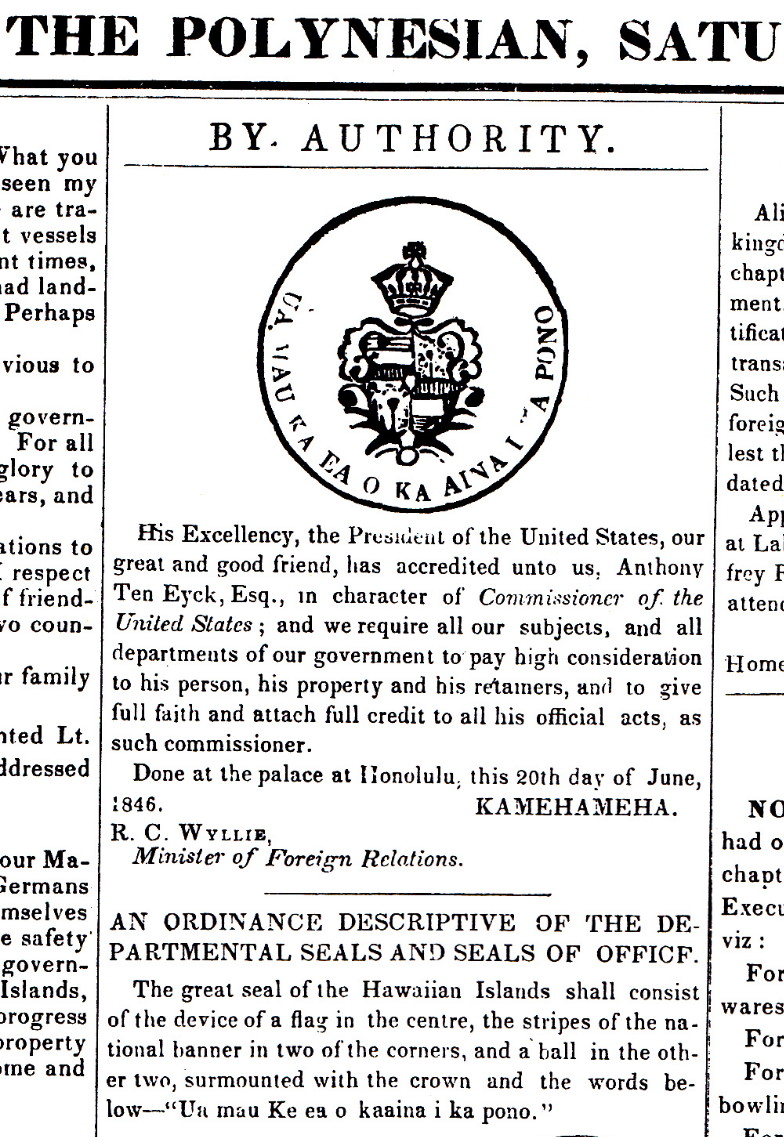
First up is an 1846 clipping (from the book Hawaii Great Seal & Coat of Arms). This is the first ever public description of the seal (with illustration included). The middle bottom paragraph is the official description of the Great Seal of the Hawaiian Islands.

IMG_0001

But wait…

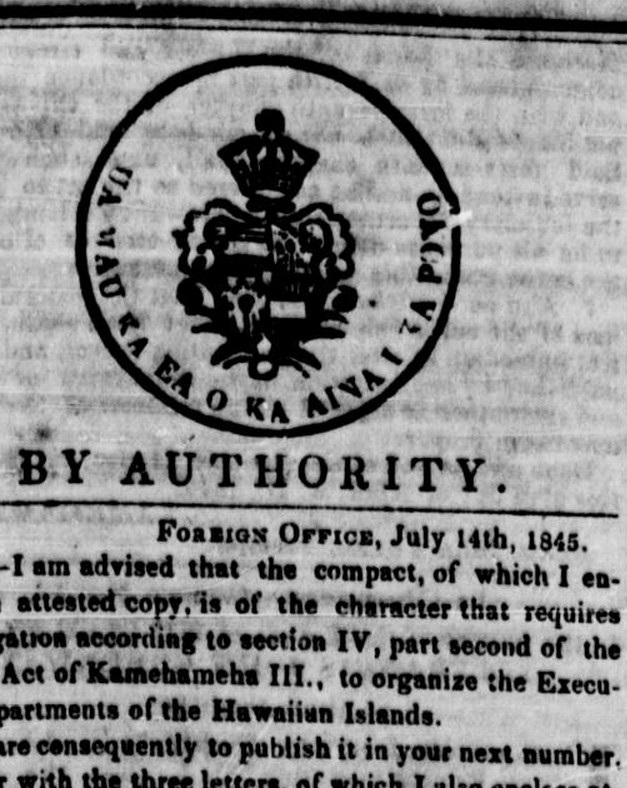
The seal was used in a 1845 newspaper from the University of Hawaii archives.

seal1

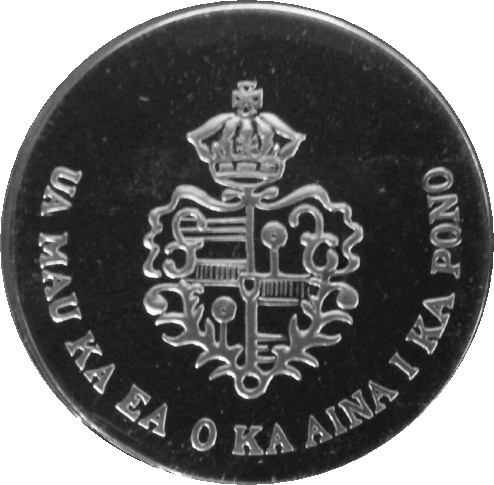
Here is the modern replica in my “in work” book (fills gaps in the Medcalf & Russell 1991 catalog).

silverseal

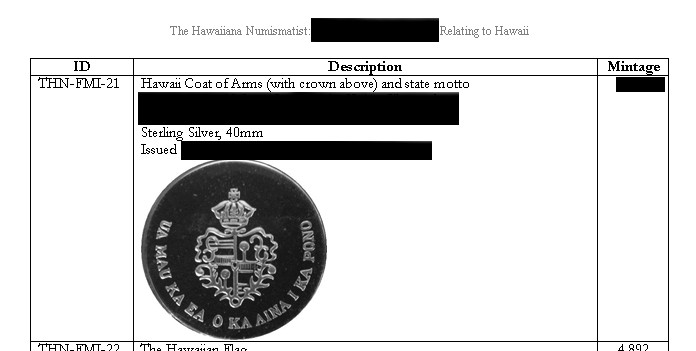
More details ….

the seal


Book soon to be available ….

Update: So Called 50C (SC50C) Hawaii Statehood Medal

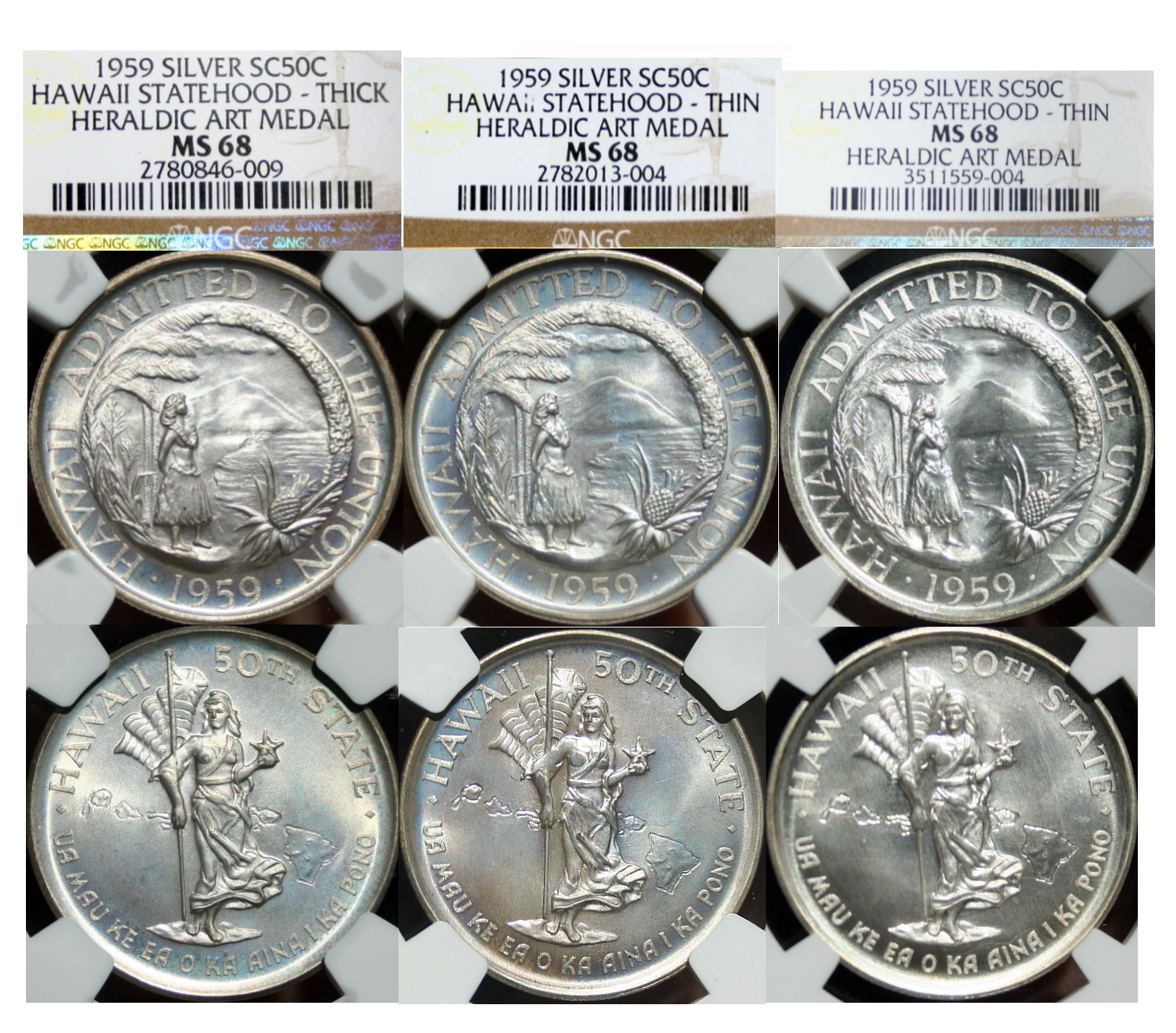
I’m in search of a specimen to disprove a theory. I’m looking for a low volcano thick specimen.

The theory is low volcano die was used first on thin planchets. The high volcano was latter used on thin planchets. The high volcano die was then used on thick planchets. To disprove this theory I must locate a low volcano thick planchet specimen (which should not exist).

Image shows from  right to left my theory. The specimens are in my personal collection.

CLICK IMAGE TO ENLARGE.

CLICK AGAIN TO SUPER ENLARGE.

the50cscdset

My original post was :

https://thehawaiiananumismatist.com/2013/03/03/new-discovery-2ms-4-aka-sc50c-1959-hawaii-statehood-heraldic-art-medal/

HA

HA is the stock symbol for Hawaiian Holdings Inc. The parent company of Hawaiian Airlines.

In 1977, the  Franklin Mint issued a proof silver ingot for Hawaiian Airlines, Inc. This was ingot No. 1 from the Airlines of the World Emblems set.

In 1999, the Royal Hawaiian Mint issued  medals (same obverse and reverse design, but one struck in silver and the other in cupra-nickel)  to celebrate its 70th years of service.

Why discuss this company?   I have vested interest as a stockholder.

HA is 3rd current top performer in  my portfolio with broker X.

hal

Repunched Date – 1996 Princess Kaiulani Gold Hapaha

The US Postmaster at my local  Post Office handed me my latest acquisition today. A rarely seen Royal Hawaiian Mint 1996 Gold and Silver Proof set. Only 250 sets were assembled. The key coin in this set is the 1996 Princess Kaiulani Gold Hapaha. Below is my new set.

rhm2

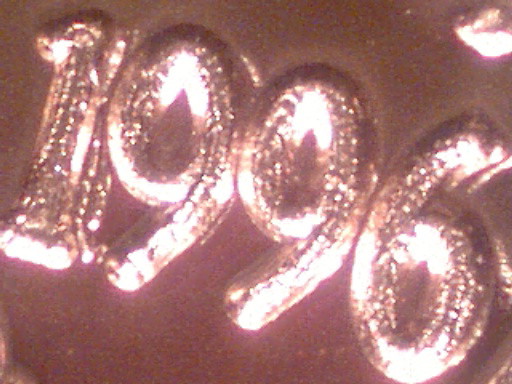
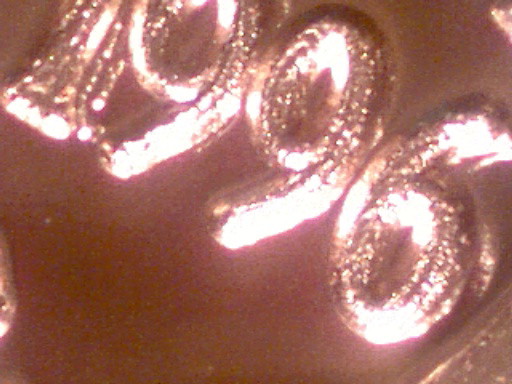
The images below are 60X magnification of the year 1996 on my specimen. Notice the multiple 1996?  Focus on the main number 1. Look to the right and see two images of 1’s. You can also see the doubling on the number 6.  Also, both 9’s have a thickness. No other parts of the coin show these symptoms.

strike1stack2

This date doubling can also be seen on two other 1996 Gold Hapaha specimens. (Click image to enlarge).

exhibit1

Here is the last Gold  Hapaha specimen.

exibit2

These 3 specimens are the same and have confirmed a repunched date.  There are no other doubling symptoms on the obverse.

This is a great find as this is the first documented minting process error from the Royal Hawaiian Mint.     Set number 89 is the discovery set for this error.