1990 Honolulu Dala Bronze Pattern

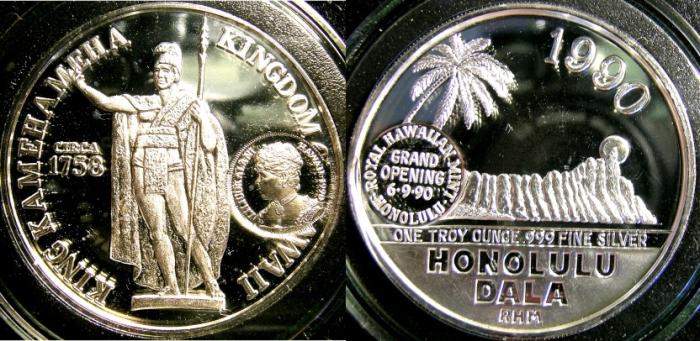
After careful inspection I came to the conclusion that the 1990 Honolulu Dala I recently acquired is in fact a rare not gold plated pattern.

The Royal Hawaiian Mint lists three  coins with the 1990 Honolulu Dala die pair (two are silver and one is a gold plated bronze).

The specimen in my possession is bronze and not gold plated. The gold plated version has a mintage of 45 and is identified as a pattern.

From this information it can be said that I have a pattern coin that is not gold plated and its population is significantly lower than the indicated 45 mintage. I believe that his coin slipped by the gold platting process and was mistakenly sold. This maybe in fact a unique specimen.

1990dala

Lead Working Sample Pattern of 2M-675

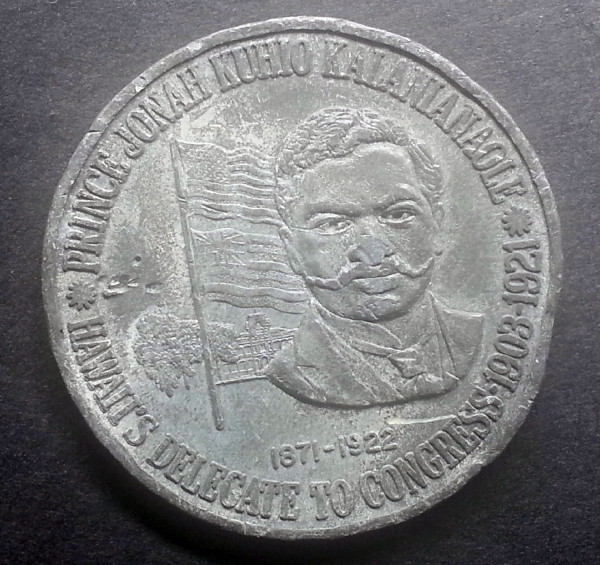
A working sample is a specimen that was not officially issued or handed over to the organization that ordered the medal. This medal has been in the specimen archive of the original minter. It has several mishandling marks, nevertheless  it’s still a rarity.

A letter of provenance was issued when I purchased this medal from company that originally struck 2M-675. I am the first individual in the chain of ownership (other than the original minter). M& R classifies  this medal as a pattern (due to it being lead). This medal then should be classified as a  Lead Working Sample Pattern.

lead1

lead2


Chinese in Hawaii Medals

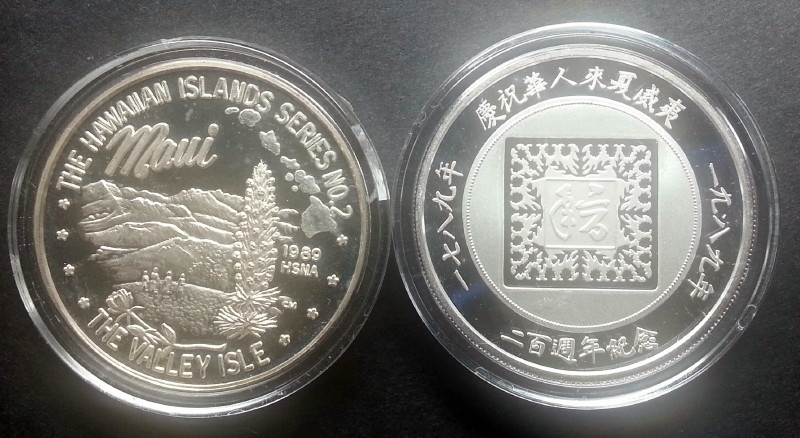
Medcalf & Russell (page 104)  identifies 5 different Chinese in Hawaii medals (2M-45 thru 2M-49). Each with the same design elements. The differences are the metal and sizes.  The only issue I have with the Medcalf & Russell listing is that the image on page 104 is of another medal (2MN-689, on page 141).

The 2MN-689 medal is on the left and 2M-46 is on the right. I hope this helps you in identifying these medals correctly. By the way, 2M-45 thru 2M-49 was struck by The Honolulu Mint.

CIH1

CIH2


1990 Hawaii Dala

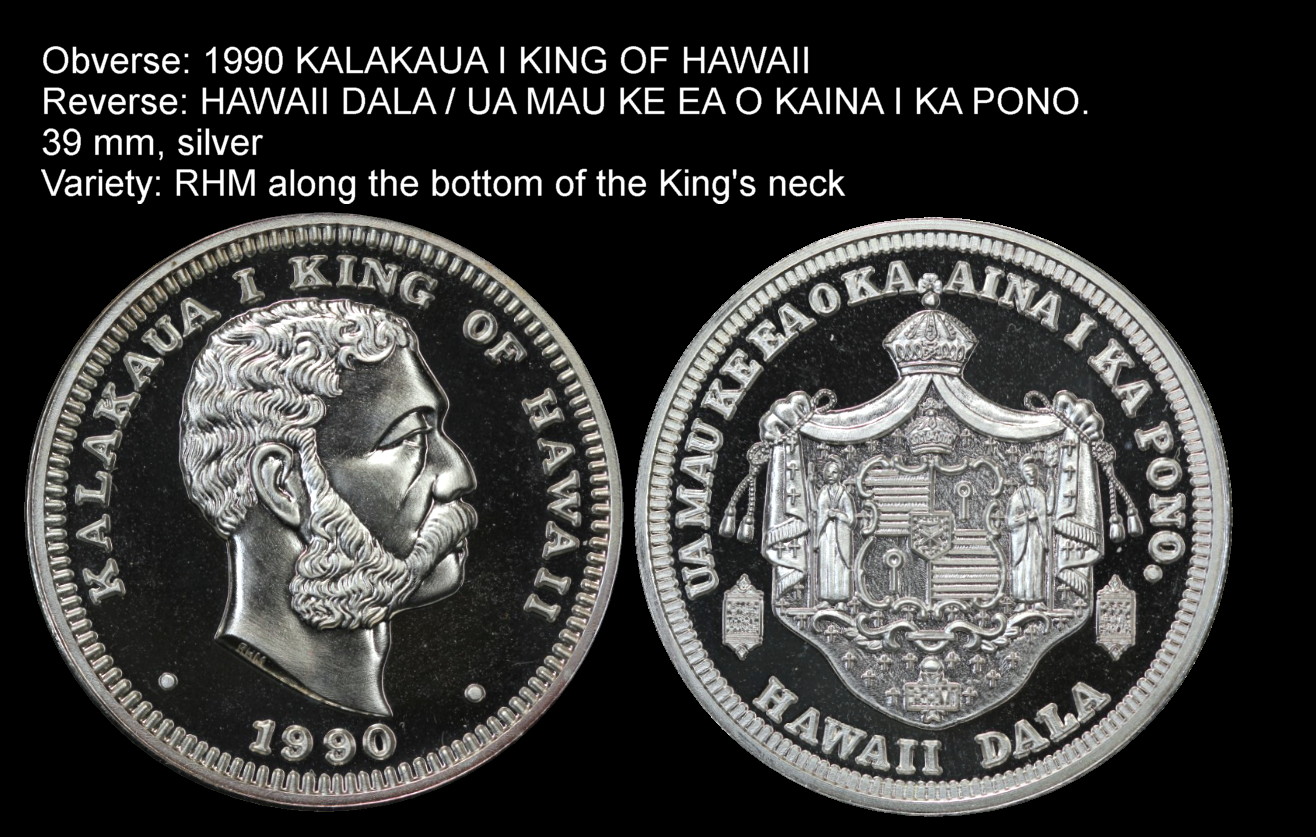
Mintage is 1250. Interesting die variety in which the initials “RHM” is located on the bottom of the King’s neckline. Click image to enlarge.

king1

Unknown Die Pair Usage: Kalakaua Centenntial Dala Obverse Die + Unknown Reverse Die

Below is an image of an unknown die pair usage from The Hawaiian Mint.

The coin is 39 mm bronze.

The obverse die was used extensively with gold, silver, and bronze strikings.

The reverse die is currently unknown and has never been seen on any of The Hawaiian Mint products.

This is the  first specimen I’ve seen with this die pair combination. This maybe in fact a pattern coin. I’ve checked my Hawaiian numismatic  resources and this die pair should not exist.

king_bronze

Hard Facts 2MB-147

For the The Hawaiian Mint (THM)/Royal Hawaiian Mint (RHM) collectors: I recommended that you understanding the cross referencing technique between the  Medcalf & Russell book and the Royal Hawaiian Mint database. It will aid you making a decision in making the purchase of a THM or RHM issue.

As an example, there is a 2MB-147 (in 18K gold)  listed today at a relatively large auction site. Lets investigate this specimen identified as 2MB-147.

1) Look on page 135 of M&R. yes, 2MB-147  is listed there.

2) In the RHM database go to the start of the year 1981

3) In the RHM database, find the die pair (obverse King Kalakaua and reverse 1981 Aloha Pineapple) matches.

4) Did you get 3 rows with the die pair match? (24K gold, sterling and bronze)

5) No 18K is  listed for the die pair match. Something fishy is happening…

6) Search for the M&R term 2MB-147. Any hits? The fish is smelling bad…

Conclusion: No 18K is listed for the die pair (Medcalf & Russell is in error). BVN did take the time to cross reference his issues with the M&R book. 2MB-147 simply does not exist (in 18K gold). There is a single 24 K gold listed in the RHM database (maybe…maybe not..). I would do a one-on-one inspection of the coin to determine is its gold plated or 24K gold.

I have a suspicion that the 2MB-147  listed is a gold plated bronze. Someone simply used M&R book to add the identifier 2M-147 on the holder. I recommend you ignore the label and inspect the coin carefully.

If you go back to the RHM database and look at the other obverse designs with the Aloha 1981 Pineapple reverse.  The Kamehameha I match is labeled  gold plated. As well as the Madame Pele match. The Captain Cook is not labeled gold plated as well as the Kalakaua obverse.  It can be said that the RHM database is in error for not listing these two (Captain Cook and Kalakaua) as gold plated. I did update my personal copy of the RHM database with this error. As for the auction listing, no thank you…I’ll pass on it….

By the way here is a bronze1981 pineapple that is not gold plated https://thehawaiiananumismatist.com/2013/11/02/1981-uniface-pineapple-design/ Would this coin sell as a bronze? Maybe as a gold plated bronze….


Unraveling the 2MB-44 Mintage Figure

2MB-44 is 21 mm coin with the  King Kamehameha I obverse and 1981 Pineapple design reverse. The “Pineapple” design has the words “ALOHA / 19 / (center figure of a pineapple) / 81 / MINTED ON THE BIG ISLAND”. Medcalf & Russell (M&R) indicates it’s bronze with a mintage of 650. The Royal Hawaiian Mint (RHM)  database indicates it’s bronze that has been  gold plated and with a mintage of 1250.

Note: M&R describes the coins as “MINTED ON HAWAII”. In reality, it’s “MINTED ON THE BIG ISLAND”.

Note: The gold plated coins can be easily spotted with the proper knowledge.  I’m not sure why The Hawaiian Mint issued a 24KT version and a gold plated version of the same coin design. It actually helps dishonest individuals immediately, by removing the gold plated coin from its packaging  and selling it as an actual  gold coin without its packaging. As a warning, I urge you to know the difference between a real gold coin and a gold plated coin.

I have to believe by the RHM mintage figure of 1250. In addition, M&R never mentioned that 2MB-44 is gold plated bronze.

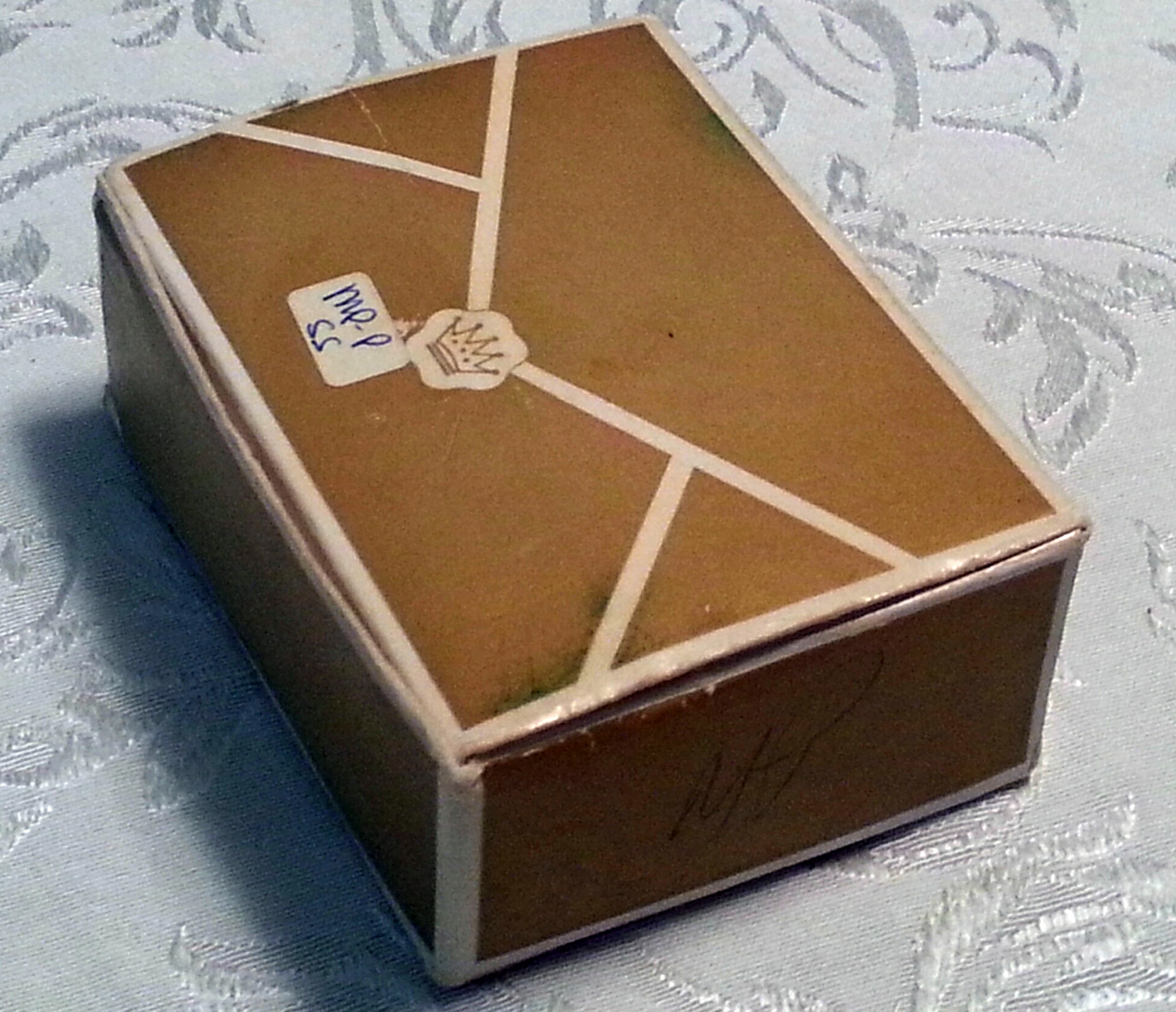
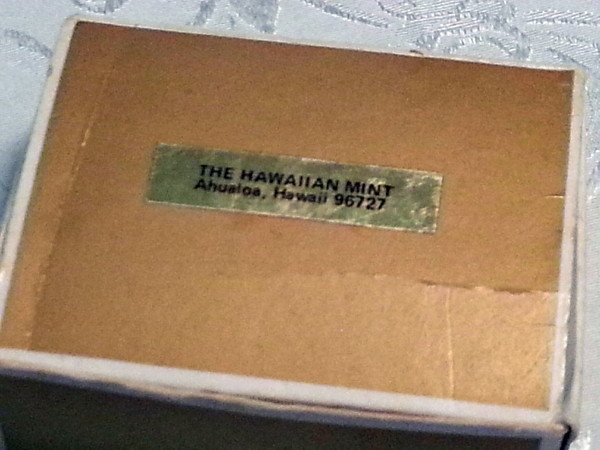
One of the basic collector rule is to keep all original packaging of the item being collected. It will aid in authentication and help boost its resale value.   Below is a 2MB-44 in its original coin holder and issued box. The inventory  sticker (MP-P SS) on the top of the box is a normal inventory practice that The Hawaiian Mint used and can be seen on their product packaging. On the bottom of the box is the company’s gold sticker (another practice used to label their products). Both stickers legitimize the box as an originally issued by The  Hawaiian Mint.  As for the coin holder, its all original and sealed.

set5

set4

set3

set2

set1


An un-plated uniface version of the pineapple design in my collection can be seen at  https://thehawaiiananumismatist.com/2013/11/02/1981-uniface-pineapple-design/

Anomaly with the 1990 Honolulu Dala (2M-184) with Counterstamp

I’ve noticed and documented (in my personal notes) that the shape of the 1990 Honolulu Dala (cataloged as 2M-184 in Medcalf & Russell) has been altered with the  first day of issue counterstamp. The anomaly is that the shape of the coin is not longer perfectly round.  I experienced the shape anomaly first hand  after trying to fit a specimen I purchased in to a protective 39 mm capsule. It would simply not fit. What I noticed was that the first day counterstamp was struck very close to the edge making the rim expand outward causing the altered shape.

Below are two examples. Look at the rim area near the counterstamp for the shape anomaly.


tf2

1990round


Page 308 of the book Unusual Wold Coins 6th Edition, by Cuhaj & Michael, issued by Krause Publications list the coin as X#MB52 and provides an image that also reflect a more pronounced  shape anomaly.

The shape anomaly is attributed to the size of the counterstamp. The counterstamp on this coin is 13 mm, where as the other RHM counterstamp coins use a 10 mm counterstamp.