My New Maui Coin Club Medal Specimens

One evening (December 2013) I was populating the Hawaii State section of a website with specimens from my collection. I was at the point where I completed the addition of my 1974 Maui Coin Club (MCC) uniface medal to the database.  Curiosity about this medal made me research the internet for duplicates and other MCC medals. I received no search hits.

After re-reading the MCC pages in the book, Hawaiian Money Standard Catalog 2nd Edition by Medcalf & Russell, I searched for the minter, Pressed Metals Products (PMP) from Canada. I received a hit, clicked on it, and was directed to PMP official website. I explored the website and found images relating to the MCC medals. I send an email to PMP requesting permission to use the images for the website. I did indicate that PMP would receive full credit as the source for the images.

PMP was the original minter of the Maui Coin Club (MCC) medals issued between 1973 through 1981. MCC disbanded in 1981. After a few days I received a reply from PMP. They denied me image use rights based on the fact that MCC owned the designs and their approval was required.  I immediately provided evidence that the MCC organization was no longer active (sent images of pages 120 and 121 from the Hawaiian Money Standard Catalog 2nd Edition).  At that point, PMP was supportive with my request and granted me image use rights for the website.  They also asked if I could use better quality images. I replied “yes”.

PMP searched their archive and found several MCC “working samples” or simply “samples”.  Samples are struck at the same time as the original order.  A sample was used to judge the quality of the medal from the production run and was later placed in their archive as a reference.

Organizations ordering medals from PMP are told samples are kept. It is unlikely that these organizations are aware in the existence of PMP’s archive of samples.  All samples within PMP archive has never left their minting facility and are not considered “issued” medals.  Samples are not re-strikes. PMP destroys dies that reach the age of 10-years old. In the case of MCC, no MCC official claimed the MCC samples before or after MCC disbanded. Images of the MCC samples were provided to me to use at the website.

In one email exchange, I inquired about my 1974 MCC uniface medal (PMP later provided very helpful information).  In the same email, I jokingly asked if I could buy a few MCC “samples” for my collection. I believed it would be impossible to buy any in their archive. I was pleasantly shocked in that they entertained the idea of selling their archived MCC medals to me. They asked for an estimated value for each medal and I provided it.

After a few days, they made the decision to sell their MCC samples to me since they were collecting dust and it would be in better hands with someone who would appreciate them. They ask me to provide a buy price. I quickly provided a buy price for their entire inventory of MCC samples.

A few days later PMP sent an email indicating they found two more MCC samples in their archive and provided me with an amended buy price. I agreed to the terms of the amended buy price with two conditions. Condition 1: Do not clean the medals. Ship them to me as how it was found in the archive. Condition 2: Provide me a letter of provenance (with a signature by a company official) indicating I am the original purchaser of the MCC samples, include a complete inventory of the purchased MCC medals, and their status as MCC working samples.

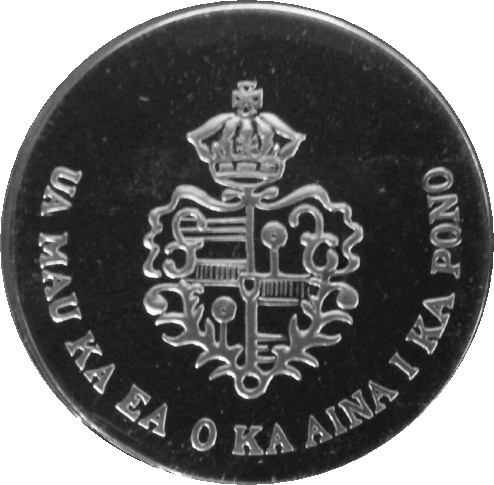
The MCC medals were delivered today. I am the proud owner of rather unique set of MCC medals. Below is one of the medals received today. Click to enlarge.

2m317

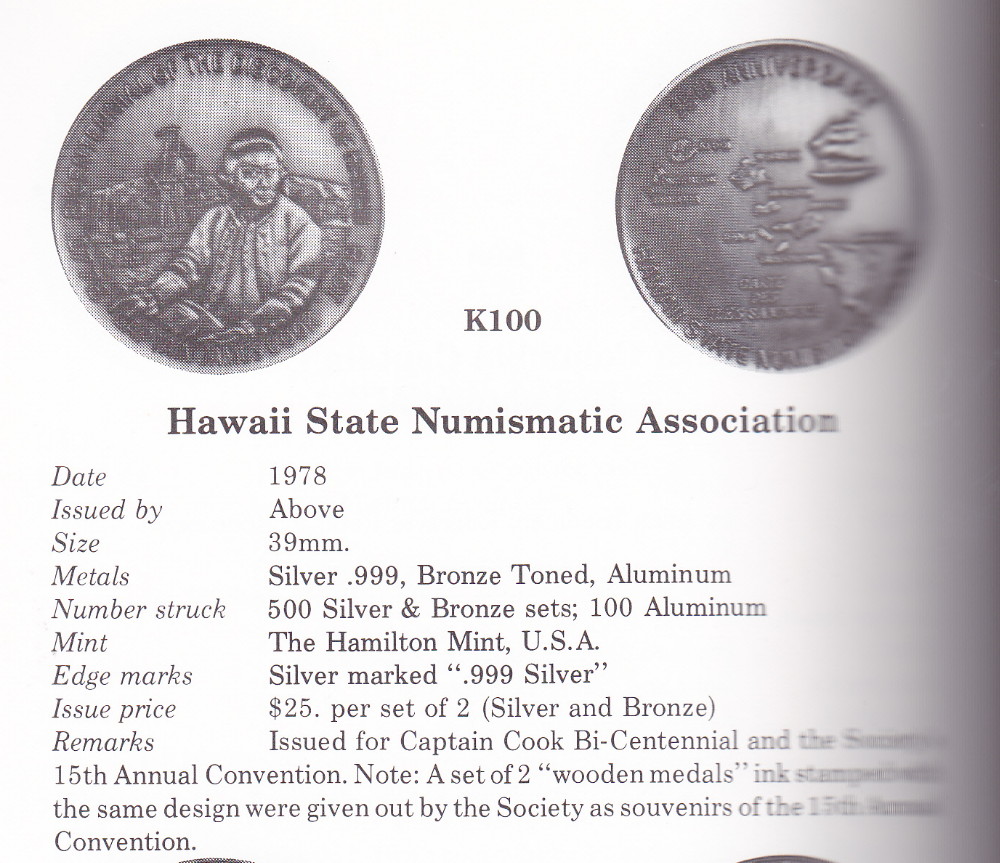
The Face of Captain Cook: A Record of the Coins and Medals of James Cook

I searched the world for this book and found a copy in the United Kingdom. I purchased it from an  antiquarian book shop. You may search Amazon.com but none will be available. This is an out of print book that was published in 1983. Written by Allan Klenman with a Foreward by William J. Mira.

This is an excellent reference book for Hawaiiana numismatists. There are several medals with Hawaii ties. In fact M&R is used as a reference (along with the Medcalf & Fong book). Very detailed information about the coins and medals (and with pictures!).

Here is a sample of K100 (K reference numbers is used in the book). Sorry for the quality as this is a “like new book” and I did not want to upset its pristine binding (i.e. did not force it down onto the scanner).

cc1


New 1991King Kalakaua Dala Die Discovery

Remember a few blogs ago I wrote about the Princess Kaiulani Silver 1/10 ounce Die Discovery by identifying new initials on the obverse die? Here are the links to those blogs:

http://wp.me/p3eNTe-hW  and http://wp.me/p3eNTe-h3

Well, I made another discovery on a 1991 King Kalakaua Akahi Dala. The same  initials are also present on this coin. In addition, a new RHM can be seen on just about the “wb” initials.

new discovery

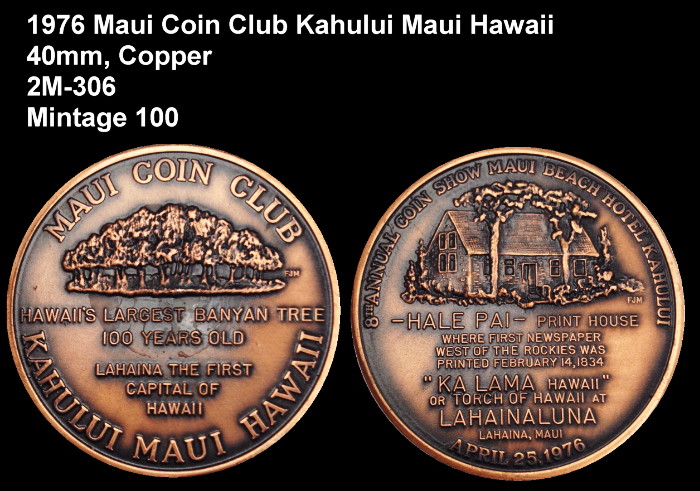
2M-306

Acquired a copper version of 2M-306. I’m not sure why M&R lists two medals (silver and copper) with the same identifier. A set will most likely be broken. I believe the silver mate to this copper medal was melted for its silver content. Once again, this visual example will help you correctly identify 2M-306. Also, if you compare the description of 2M-306 (page 120 of M&R) you will see the discrepancy in missing information.  Enjoy!

Club


Alapi’i Collecting

Alapi’i collecting is the special term I use in collecting a specific type of Hawaiiana numismatic material.

The Alapi’i Collector.

The English translation for the Hawaiian word alapi’i is “step”. In this type of collecting, the collector collects by steps.  In alapi’i collecting, the exact numismatic design is collected with three possible steps in mind:

1)      Metal composition step

2)      Diameter size step

3)      Finish step

As an example, a collector acquires an available specimen with the exact same design, but in different metal compositions and sizes. An example is the Hawaiiana numismatist that collects a particular Hawaii Statehood medal design that was struck on a planchet in sizes of 39mm, 32mm, 13mm, and in a variety of metal compositions such as sterling silver, 24KT gold on sterling silver, bronze, and platinum.

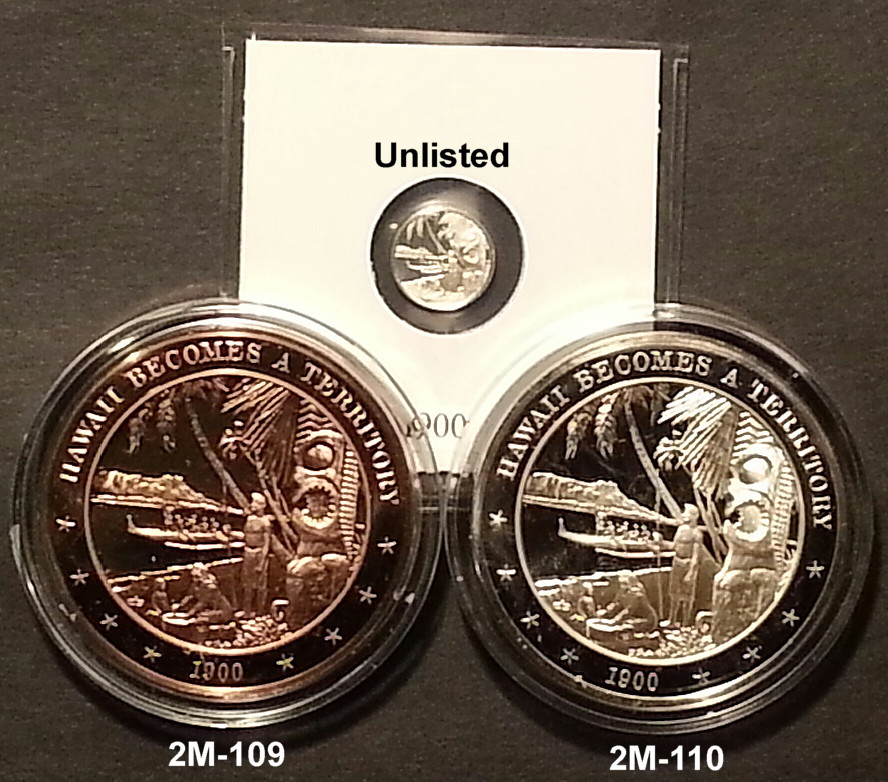
Here is an example  alapi’i set.

alohastate

The goal of alapi’i collecting is to secure a design specimen in  a combination of steps or all available the steps. The Franklin Mint issues have an abundance of Hawaiiana related items that fall into the category of alapi’i collecting.

The first difficulty of the alapi’i collecting is the availability of the individual steps. In order to acquire an alapi’i specimen, a completed set must be either broken-up with the individual specimens made available for sale or an entire set purchased and cannibalized for the desired specimen(s) with unwanted pieces dispersed for re-sale.  This is where the term collecting takes heart. One must be patient and diligent to locate the step specimen for sale. One must be on constant watch to locate a particular step specimen, as sets are broken up at irregular intervals.

The second difficulty in alapi’i collecting is the limited number of available Franklin Mint sets. Several of the Franklin Mint sets are limited issued and fall in the category of single or double digit mintages. The Hawaiiana Numismatist is also competing with the Franklin Mint set collectors for these limited sets. And in most cases the only means to acquire a step specimen is by direct cannibalization of a completed set. This can be cost prohibitive as most completed sets command a premium.

The third and  final alapi’i collecting difficulty is the incomplete and inaccuracies in current Hawaiian numismatic reference books. Hopefully, the book  I am in the process of writing will start the trend in  alapi’i collecting  and assist Hawaiiana numismatists with a more comprehensive and accurate listing of the Franklin Mint issues.

Here is another  alapi’i set with a unlisted step. (An example of  inaccuracies in the 1991 Medcalf & Russell book).

seta

The Great Seal of the Hawaiian Islands

Did you know that there was a modern replica of the Great Seal of the Hawaiian Islands?

First let’s scan a few newspapers from the past.

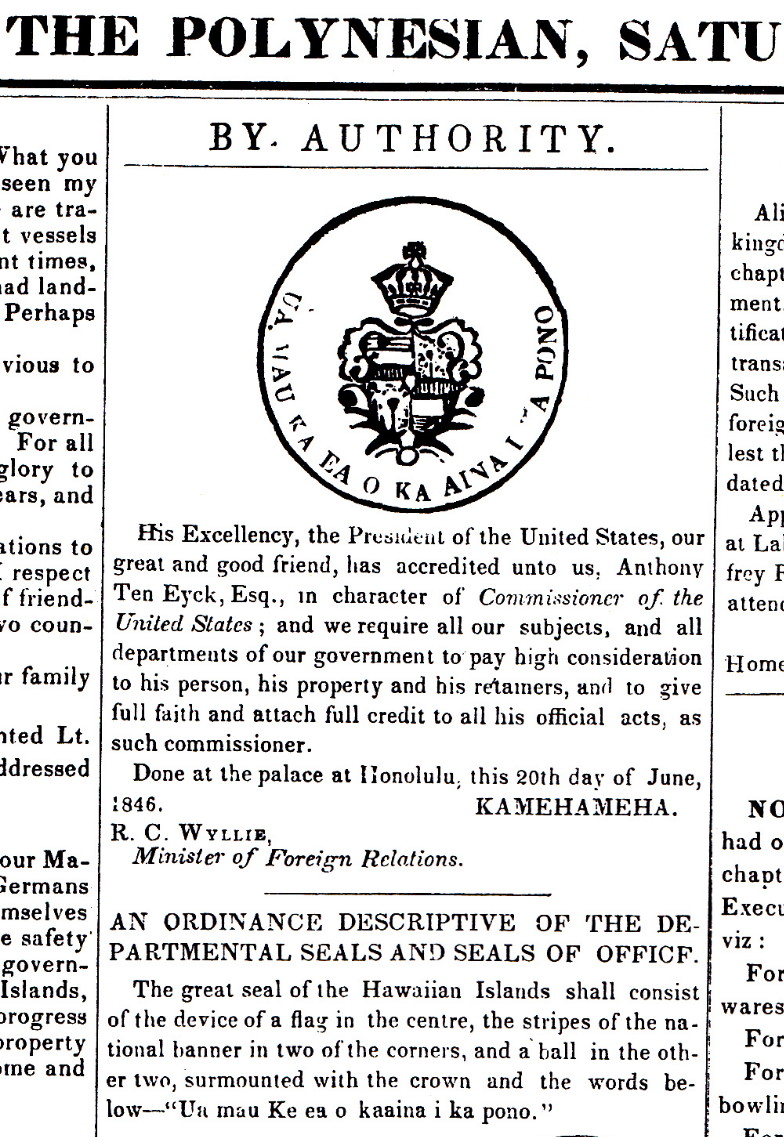
First up is an 1846 clipping (from the book Hawaii Great Seal & Coat of Arms). This is the first ever public description of the seal (with illustration included). The middle bottom paragraph is the official description of the Great Seal of the Hawaiian Islands.

IMG_0001

But wait…

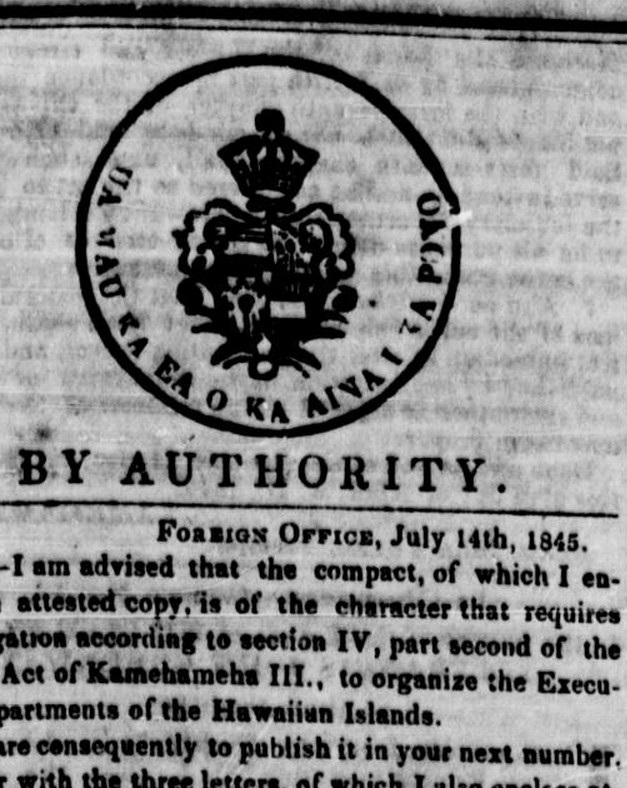
The seal was used in a 1845 newspaper from the University of Hawaii archives.

seal1

Here is the modern replica in my “in work” book (fills gaps in the Medcalf & Russell 1991 catalog).

silverseal

More details ….

the seal


Book soon to be available ….