New Hawaii Coins

Treasure Chest Coin Company are selling several coins related to Hawaii.

This is the Hawaiian Marlin Coin

http://treasurechestcoincompany.com/products/copy-of-marlin-medallion-in-1-oz-silver-copy-of-marlin

This is the Alaskan Marlin Coin

http://shop.alaskamint.com/Marlin-Medallion-with-24k-Gold-Relief-MARLINGR.htm

These coins have the same obverse design with a different reverse design. (Hawaii version is +$75 more than the Alaskan version).

A few of the Hawaiian version coins have been appearing on eBay.

http://www.ebay.com/itm/Alaska-Mint-Stingray-Gold-Silver-Medallion-Proof-1-Oz-/361272733481?hash=item541d886f29:g:sPoAAOSwymxVMPXH


Reason for No Entries

My father was is dire condition and I flew back to Hawaii to be by his side and my family. I stayed with him at the hospital and the hospice. I stayed overnight to watch him. He peacefully passed away on the evening of October 24.

On Sunday October 25, to get my legs moving and head straight I spent a few hours at the Hawaii State Numismatic Association (HSNA) show. I did not purchase anything,  but met several of the members of the HSNA and Honolulu Coin Club.

Hopefully, I can give a lecture to the club on my next trip to Hawaii.

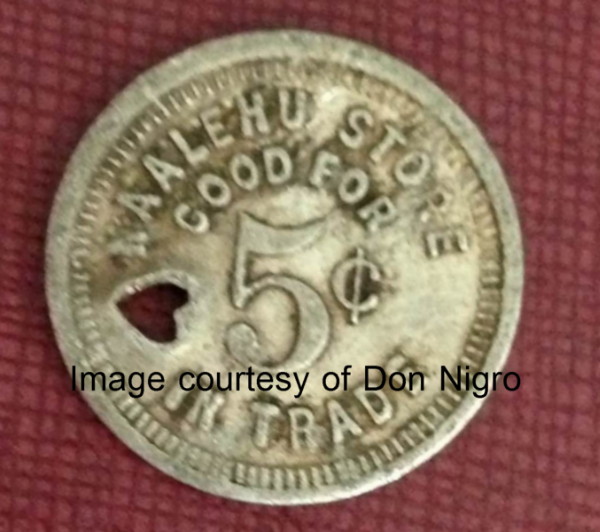
New Find By Don Nigro: NAALEHU STORE GOOD FOR 5C Trade

Great find by Don Nigro. of Hawaii:

Don states that ”

Don Medcalf says its a discovery piece he’d never seen before. It’s 13/16th of an inch diameter; and is aluminum.
I like this token! Both my grandfather and father worked the Hutchinson Sugar Plantation on the Big Island. Eventually they lived  in Na’alehu. My dad calls Na’alehu his hometown. I will contact my dad and see if he remembers the store and token.
Thank you sharing Don! (I can’t make the HSNA show this month. I don’t have the trading material for this token).
don1
Now that Na’alehu was brought up…I want a taste of  sweet bread! (My dad sends me bakery items from this shop in Na’alehu every so often). http://www.bakeshophawaii.com/

My Book Swap with a Well-Known Numismatic Author

While surfing the internet for items about Frank Gasparro (U.S. Mint Chief Engraver),  I came upon a website dedicated in listing medal artist with their works of art. This is biography.

D. Wayne Johnson

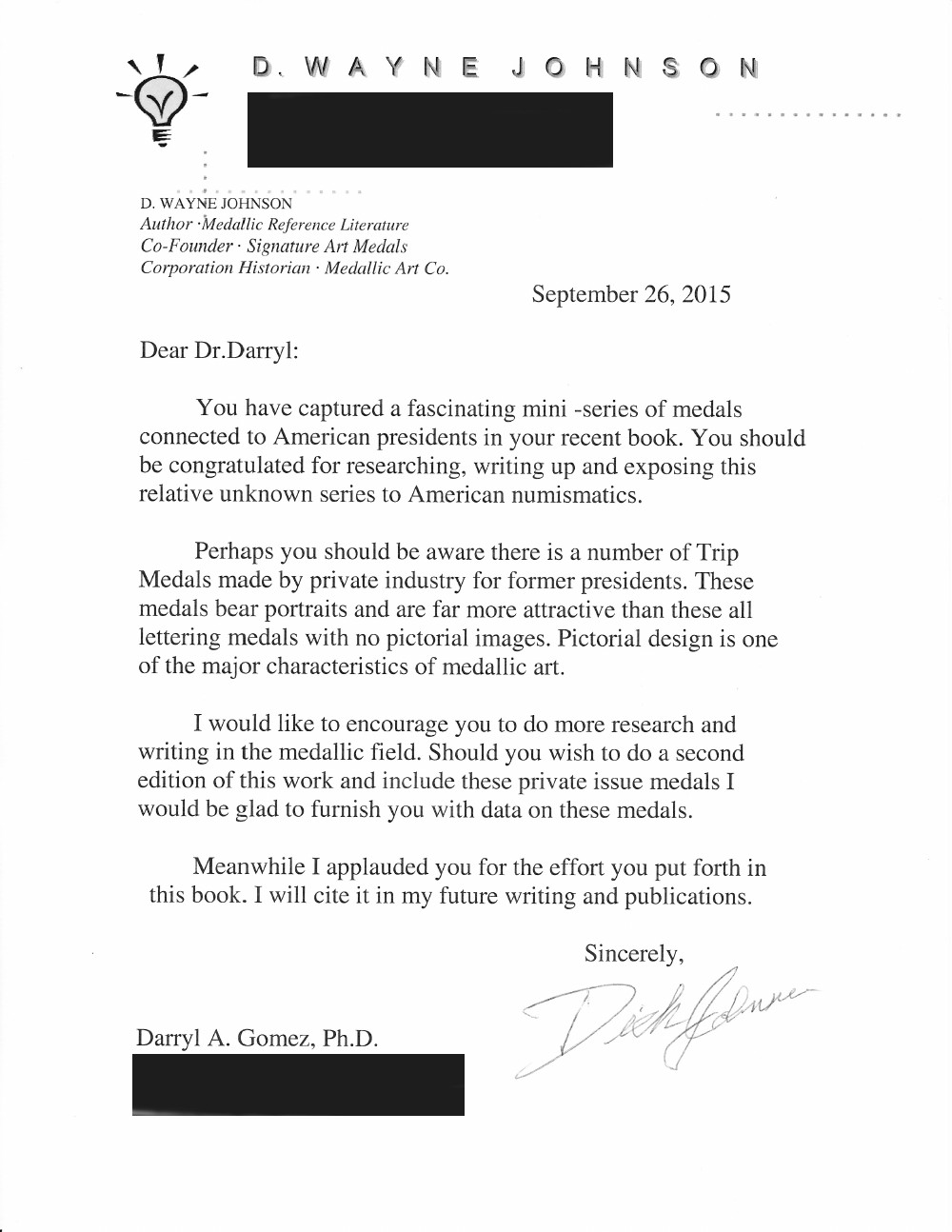
We exchanged emails after I identified several of Frank’s undocumented works as it relates to presidential medals. We exchanged book and this is the enclosed letter….

book1

Souvenir of Hawaii: An Analysis of HK-722a (Also Known As 2M-390)

The 1991 dated book Hawaiian Money Standard Catalog 2nd Edition by Medcalf & Russell assigns a catalog value of $20. There is no population or rarity assigned.

The 2008 dated book So-Called Dollar by Hibler and Kappen assigns a catalog value in the range of $75 to $300 in uncirculated grades. A population estimate is assigned between 21 to 75. This is a  R-6 using the Fuld rarity scale.

Both books fail to mention that two types of specimen are available: Intact and Holed. The holed version has the “49” drilled out.

NGC grading standards reflect that holed specimens will be assigned DETAILS grade. The current NGC population is 3 for intact specimens (1 @MS62 and 2@MS63).

The John Raymond So Called Dollar Tabulation reflects that there was no HK-722a identified as being sold through mail bid dealers and auctioneers from the years 1975 through 2000.

Recently, there was an intact HK-722a sold at eBay. The hammer price was $280. I would conservatively grade this medal MS60. However, this is an intact specimen making it even more desirable when comparing it to the current NGC population of 3. Recent eBay sale

I give a thumbs-up to the purchaser who picked up this intact “49” rarity.

Hawaii Promotion Committee Link to HK-721 SCD?

The 1904 “Automobile Floral Fiesta” (originally held on Thanksgiving day) evolved into the Floral Parade and moved to Washington’s Birthday (Feb 15, 1906). No parade was held in 1905. The name later changed to only the Mid-Pacific Carnival. The Mid-Pacific Carnival continued to spotlight the Hawaiian Islands until 1917. It was decided that the 1918 Mid-Pacific Carnival be held at an appropriate level (limited to athletic contests) due to the efforts of the U.S. in World War I.

From 1904 through 1917, the primary motive of holding the event was to produce a revenue stream for the Hawaiian businesses (tourism and investments). The Hawaii Promotion Committee was in charge of the annual event. The Hawaii Promotion Committee was part of the Honolulu Chamber of Commerce.

In order to promote the event, an annual contest (only for the years 1910 through 1917) was held to select a poster design. The winning poster design was printed into posters, postcards, and stickers. These three forms of media was sent throughout the world to publicize the event.

The stickers (name the Hawaii Promotion Committee used) are know today as “Poster Stamps”.

The advance Hawaiiana specialist seeks the “design trifecta”, that is, own the poster, postcard, and sticker. This is an extremely difficult task to accomplish as most of the posters were trashed after the event. Stickers were attached to anything that was not moving. As for the postcards, they are highly prized by specialized collectors.

It is my opinion that the posters and stickers are highly valued since many did not survive due to their uses as disposable advertising. The postcards were advertising on a form of written communication and kept after being delivered.

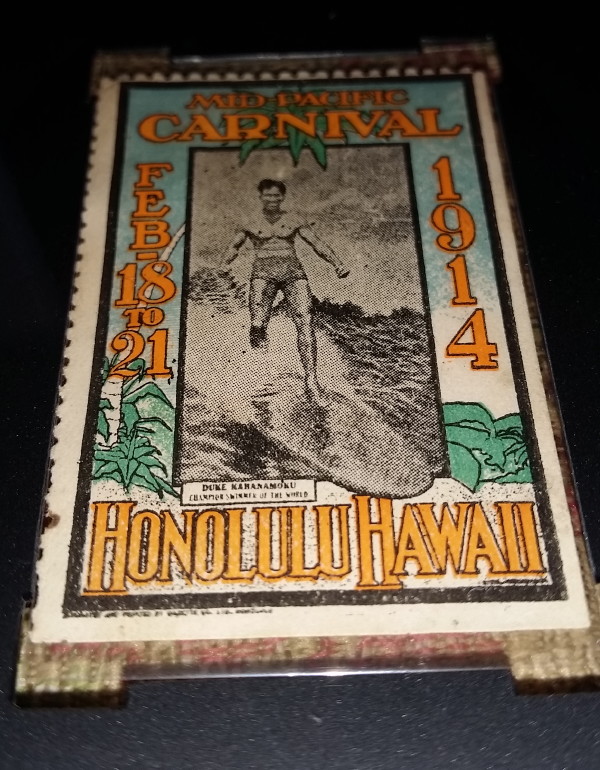
The most highly prized design is the 1914 Mid-Pacific Carnival. It features the father of modern surfing, Duke Kahanamoku.

This is the 1914 Mid-Pacific Carnival Poster Stamp in my collection.
dk1

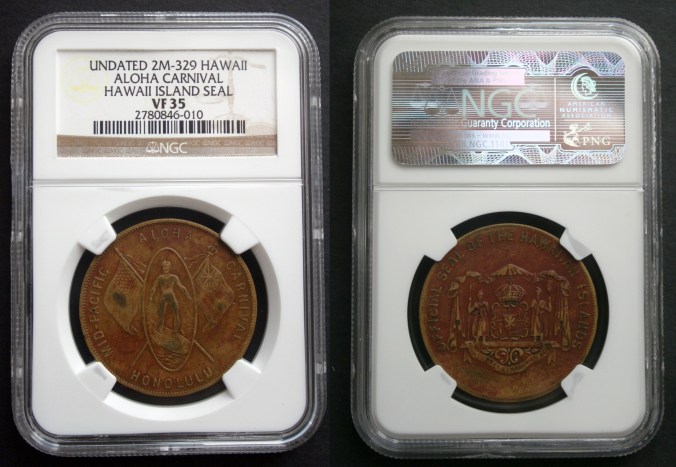
Here is Duke in the same pose on a 1914 Mid-Pacific Carnival So-called Dollar (1 of 3 HK-721 SCD my collection).
duke