
I created a write-up at my ANA blog about the 1918 Mid-Pacific Carnival gold medal. Enjoy!
I created a write-up at my ANA blog about the 1918 Mid-Pacific Carnival gold medal. Enjoy!
An interesting weekend on eBay as it relates to Hawaii Statehood medals. One particular item is the obverse and reverse dies of 2MS-4 that sold for $1009.
As you know, I documented the high volcano and low volcano varieties four years ago.
Below is the original image that was used to identify the two volcano varieties. Left is the high volcano variety. Right is the low volcano variety.

The recent auction of the obverse and reverse dies reflect that the volcano is low (original image flipped on the left). The die matches the right image above. Notice the separated clouds and the volcano slope is at the hula girl’s chin.

The low volcano variety was used on the thin medals and gold medals. Below is a gold medal.
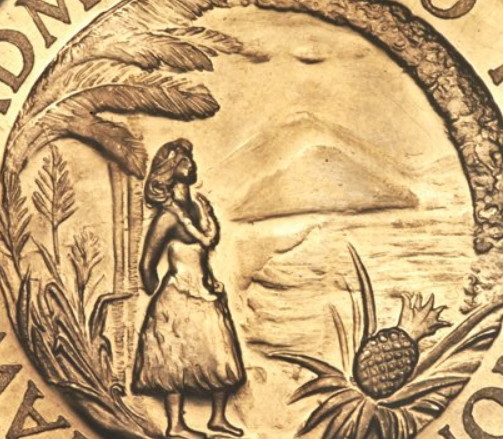
I have yet to see a low volcano on a thick medal and gold medal.
What does this mean?
The dies sold on eBay is from the first striking of the thin and gold medals.
My ANA blog also documents the low and high volcano varieties.
http://thehonolulumint.com/index.php
The Honolulu Mint joined the Northwest Territorial Mint (as indicated on their website). New images of their products is also at their website (http://thehonolulumint.com/our-products.php)
Hammer price was $483.
Except there was a problem…
RHM database and MR book indicates that the coin is serial numbered from 1 to 78. This coin is not serial numbered.
According to RHM database, the mintage for this coin is 43 !
M&R indicates a mintage of 66!
The rarity of the coin was incorrectly stated in the ad….( I would use the direct source (RHM database) as the more accurate mintage (43 without serialized number).
Rare bronze set (mentioned in M&R, page 150, “a few bronze examples were issued”). Nohu Pinao (Hawaiian Lionfish) unlisted in silver.
The Lionfish was our class pet when I was in kindergarten. The number 1 class rule was no hands in the fish tank. 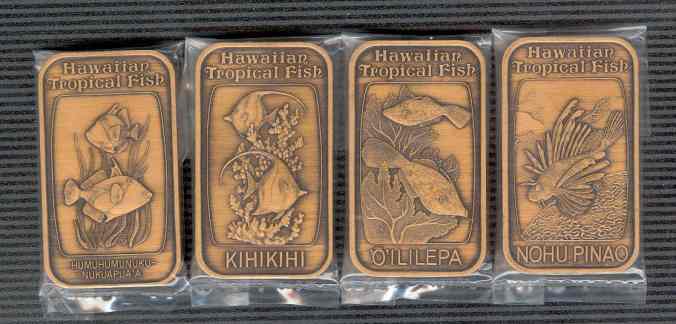
She (my wife…image below) likes gold coins. My wife is part Native Hawaiian, part Okinawan, and part Caucasian. It’s befitting for her to have her own Hawaiiana collection. I gave her my Princess Kaiulani collection (gold, silver and other metals). She adores each of the 1 ounce gold Princess Kaiulani issues from the Royal Hawaiian Mint.

Somewhat related to the Hawaiiana numismatics (1960 Eisenhower Hawaii visit medal). I re-used my YouTube video that presents my research finding for the Hawaii visit model (near the bottom of the POTUS sGm webpage).
I created several US Numismatic Discovery Models. Several of these models can be adapted for Hawaiiana numismatics.
Discovery Model D is a prime example. The Hawaiian Numismatic Knowledge Domain is basically centered around the MR 2nd edition book. If a Hawaiian issue is not located in this book, its a numismatic discovery if its documented.
Here at the model write-ups:
https://www.money.org/collector/drdarryl/blog/us-numismatics-discovery-models-part-1-2
https://www.money.org/collector/drdarryl/blog/us-numismatics-discovery-models-part-2
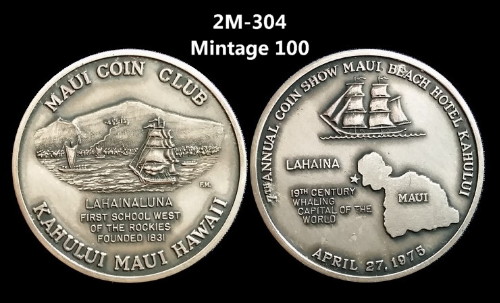
I obtained several sketches of the Maui Coin Club issues from an business acquaintance. The reduced scan is the reverse from the 1975 Maui Coin Club medal. A historical artifact from the Maui Coin Club!

Sold as a Hawaii poster stamp (advertising label) and now in my Hawaii bank collection as a 1948 advertising specimen. Label is intact (shown laying on an Official Red Book)

 The Hawaiiana Numismatist ™
You must be logged in to post a comment.