http://www.gata.org/files/VonNotHausForfeitureOrder-12-2-2014.pdf
Just Having Fun
Update: Another Wow Purchase
On 11/21/2014, I wrote about “another wow purchase” of mine.
https://thehawaiiananumismatist.com/2014/11/21/another-wow-purchase/
I finally had the time to snap a few picture of this six piece acquisition. Medcalf & Russell identifiers are in parenthesis.
From top left: HK-529, HK-530, and HK-531 (2MS-18, 2MS-16, and 2MS-17)
From bottom left: HK-532, HK-533, asnd HK-534 (2MS-14, 2MS-15, and 2MS-12)

Pride of this acquisition is the high grade 2MS-18 with only 100 struck.
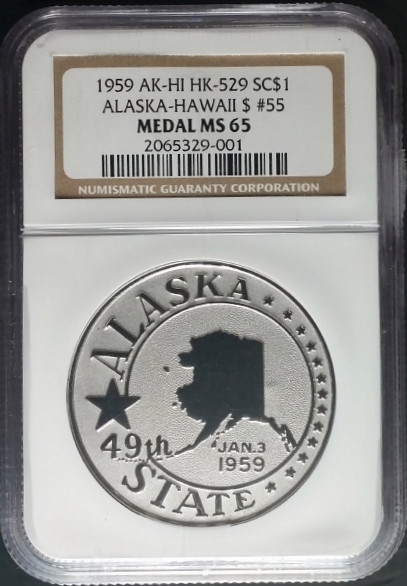

This acquisition both restores and expands my “Hawaii Statehood medal set” .
Restores the items I sold to work on my masters degree at Johns Hopkins University (https://thehawaiiananumismatist.com/?p=946). (Note: I already have the aluminum medal in my collection.
Expands my restored set with 2M-15 and 2M-18.
And finally adds to my original “wow” purchase. https://thehawaiiananumismatist.com/tag/hawaii-uniface/
This set is also related to https://thehawaiiananumismatist.com/alapii-collecting/
Go Team Hawaii !
Team Hawaii (a Kiva lending team) was created back in September 2008.
As of today the amount lent is $122,975 and growing. Impressive team impact: http://www.kiva.org/team/team_hawaii/impact
Currently, 137 members throughout the world are part of Team Hawaii.
I completed my 236th Kiva loan today. My lending profile http://www.kiva.org/lender/DrDarryl
Possibly Unique 1991 Princess Kaiulani Gold Akahi Crown
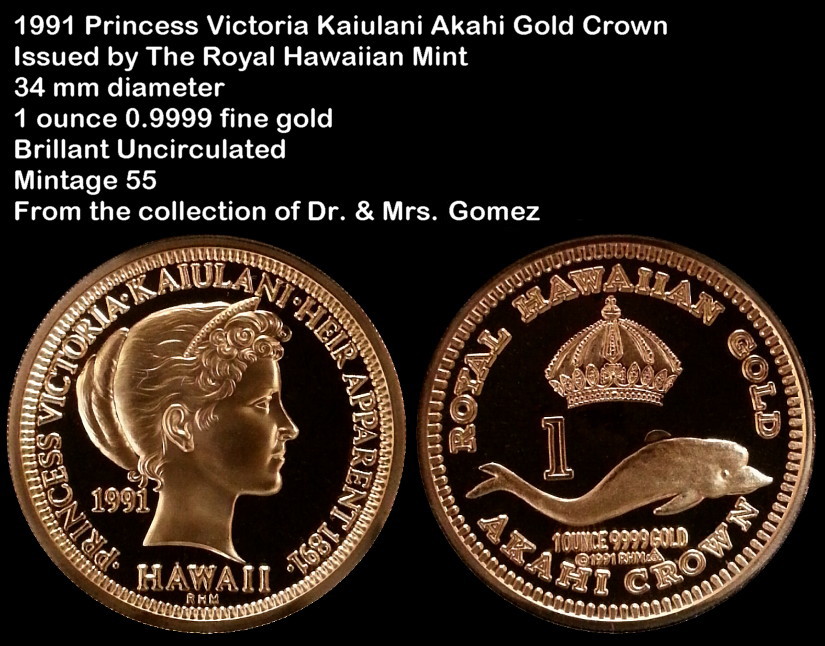
This is a beautiful addition to my Hawaiiana Gold collection. She was received this afternoon. This beauty was purchased from the Hawaiian Island Stamp and Coin located in Honolulu, Hawaii. A new World Coin identifier (Krause) is required as this First Day Issue counterstamp 1991 Princess Kaiulani Gold Akahi Crown does not have a Krause catalog number, however the coin without the counterstamp is a X# MB60.

She is a perfect match for her sister X# MB60 that is also in my collection.
Trademark Symbol Added Today
Trademark superscript symbol was added to protect brand name of The Hawaiiana Numismatist ™ ;
A trademark is a brand name. A trademark or service mark includes any word, name, symbol, device, or any combination, used or intended to be used to identify and distinguish the goods/services of one seller or provider from those of others, and to indicate the source of the goods/services.
“The mark has become distinctive of the goods/services, as demonstrated by the dated evidence.”
08/13/2012 – Free WordPress blog was establish. No entries made in 2012. thehawaiiananumismatist.wordpress.com (this is Hawaiiana)
08/13/2012 – Free WordPress blog was establish. No entries made in 2012. http://thehawaiiannumismatist.wordpress.com/ (this is Hawaiian NOT Hawaiiana)
03/03/2013 – The Hawaiiana Numismatist first blog entry
03/10/2013 – Premium Wordpress account established (more development features and larger storage capacity for images) . The domain address thehawaiiananumismatist.com was also purchased.
12/19/2014 – The Hawaiiana Numismatist ™ being initiated in use to notify the public of this unique identity. Intent is to provide a claim of this identity and distinguish it from those of others.
12/19/2014 – Purchased http://www.thehawaiiannumismatist.com/ (this is Hawaiian Not Hawaiiana) to block out potential competitors
First Hawaiian Center Dedication Medal
I added obverse and reverse images of the First Hawaiian Center dedication medal to the First Hawaiian Center Wikipedia page
https://en.wikipedia.org/wiki/First_Hawaiian_Center
Click the medal image to get information about the medal.
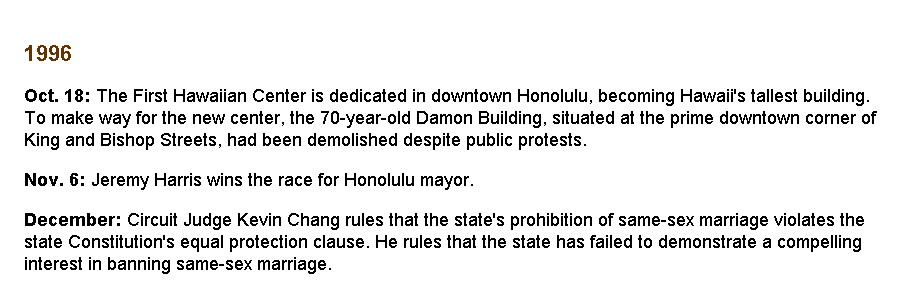
The medal is in my collection. When I purchased the medal it was misidentified as a service award. A quick check of the building name indicated it was built in 1996 and corresponded with a Hawaii Star Bulletin write-up (below). Key item of interest is that First Hawaiian Center is the tallest building in the State of Hawai’i.
Competitive NGC Registry Sets Relating to State of Hawaii
Currently, there are are NO competitive NGC Registry sets relating to the State of Hawaii. The Kingdom of Hawaii has three such sets:
http://coins.www.collectors-society.com/registry/coins/public_sets.aspx?CategoryID=42&sets=us
There is a possibility to create several State of Hawaii sets. I have contacted NGC today (via email) making a formal request based on the following information from the NGC website:
—————————-
What coins are eligible for the NGC Registry?
All NGC-certified coins are eligible for the NGC Registry, although there are not Competitive Sets for every coin. You may request a new Competitive Set by emailing Registry@NGCcoin.com. US Competitive Sets and all Custom Sets accept both NGC- and PCGS-certified coins. World Competitive Sets accept only NGC-certified coins.
—————————-
1) Hawaii Statehood Medals. From the NGC Bibliography (America Overseas Territories) Hawaiian Money by Medcalf & Russell. I request 2MS-1 though 2MS-20 inclusive be created as a Hawaii Statehood Medal Competitive Registry Set.
2) Hawaii Undated So-Called Dollars. So-Called Dollars as listed in Hibler & Kappen. I request HK-721 though HK-723 inclusive be created as a Hawaii Undated So Called Dollar Competitive Registry Set.
3) Alaska-Hawaii Statehood (combined) 1959 (Mishler Issue) So-Called Dollars. So-Called Dollars as listed in Hibler & Kappen. I request HK-528 though HK-537 inclusive be created as an Alaska-Hawaii Statehood (combined) 1959 (Mishler Issue) So Called Dollars Competitive Registry Set.
4) Hawaii Statehood 1959 So-Called Dollars. So-Called Dollars as listed in Hibler & Kappen. I request HK-547 though HK-551 inclusive be created as a Hawaii Statehood 1959 So-Called Dollars Competitive Registry Set.
These have a good change in becoming Competitive NGC Registry sets. The following are examples of subset sets (large sets are reduced to a particular focused collecting area).
If you are interested please e-mail NGC at Registry@NGCcoin.com.
Undocumented 1991 Princess Kaiulani Akahi Gold Crown with First Day of Issue Counterstamp
I’ve been monitoring an item listed on eBay since mid-November. It finally got sold. It was a 1991 Princess Kaiulani Akahi Gold Crown. 1 ounce of 0.9999 gold. This coin is listed in Waifs in Gold Boots (Royal Hawaiian Mint (RHM) Database). This coin looked intriguing.
When I first observed the coin I believed it was a gold plated silver 1991 Princess Kaiulani, but it was not.
Click image to enlarge.

An astute Hawaiiana collector should have spotted the “1” on the reverse indicating it’s an uncirculated gold specimen. The “1” is a unique identifier for the uncirculated version of the gold coin. The proof gold version would have a raised engraving pad used for serialization (1 to 400) for the 1991 Princess Kaiulani 5-piece gold proof set. The uncirculated Princess Kaiulani gold coins had a limited mintage of 55 and makes it uncommonly rare. Yes, 55 specimens.
What makes this coin more intriguing is the First Day of Issue (FDI) counterstamp (1990 Queen Liliuokalani IKI on the obverse and a Day of Issue 3-9-91 on the reverse). This is the first time I have encountered a RHM gold coin with FDI counterstamp.
By combining the two attributes (gold coin with 55 mintage and with FDI counterstamp), you can get a feel of its rarity.
Now the question of the day is: ‘How many of the 55 specimens were struck with a FDI counterstamp? ” I’m taking a guess that it’s minuscule (since its not listed in Waifs in Gold Boots). Whatever the answer is…this gold coin is extremely rare.
Below is the same coin in my collection without the FDI counterstamp.

Part 3: Lunch Tokens of Hawai’i (The Impetus)
The impetus behind the creation of the lunch school tokens was the rapid malnutrition of the children attending school in the Territory of Hawaii (early 1910s). Department of Health eventually cut funding to feed the malnutrition students. Civic groups stepped in when they could, but was only localized to a specific school and grade level(s). Teachers and other community leaders saw that a well fed student was a student that could learn at his/her full potential. Many of the students were identified as not eating breakfast and/or not bringing a lunch. In some cases, the students would seek unhealthy food from food vendor carts that came to the school.
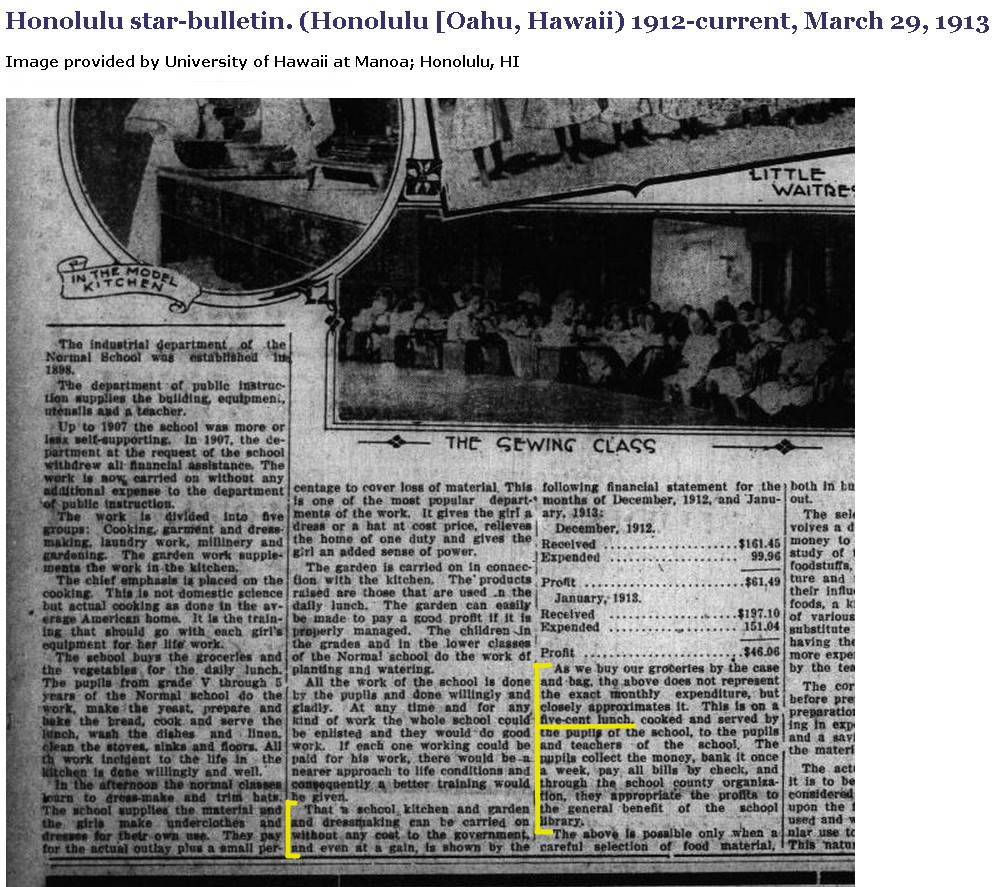
The students who could not afford lunch suffered the most. However, a self-sustaining lunch program was being developed at two schools in 1913. The Normal School was the model. The Normal School set the standard in which lunches were provided to students. A school kitchen was installed. Girls would be taught classes in cooking. Classes would be taught in gardening. Students (under training) created the meals. In fact, the school was showing a profit from its 5 cents a meal lunch program. Several dignitaries visited the school based on this program. Most of the schools began requesting kitchen equipment to aid in the malnutrition problem (and to keep the students with no home provided lunches on school grounds). Based on the school’s curriculum, the cooking classes and gardening classes provided the mechanism to provide meals.
As for the school lunch tokens, think of its start as a welfare program instituted by the school for identified students with malnutrition. As a self-sustaining school lunch program arose, those who can pay paid with legal tender. Those who were identified as students with malnutrition where provided free lunch tokens (and most likely performed a school task in exchange for the token, such as cleaning).
As the lunch program grew, the lunch tokens were sold to the students at the beginning of the month. This was mostly likely to obtain funds in advance to pay for the food supplies for the oncoming month. But again, the underlying reason for the inception of the school lunch program is that it provided the means to aid low-income students to be fed by providing free school lunch tokens for meals.
Part 1: Lunch Tokens of Hawai’i (Kapaa School, Kauai)
It was requested that I start to investigate and uncover more information about the lunch tokens of Hawai’i. After a few clicks this is my first find, a 1919 news article from The Maui News (Wailuki, Maui, T.H.) about the free lunch school program on the island of Kauai.
The Kapaa School (Kauai) is mentioned and the price of lunch was 5 cents. The school, price, and location correlates with M&R 2TL-49, 2TL-50, 2TL-50a, and 2TL-50b. The 1919 year is just a date of when the free lunch program was documented as being active and not when the tokens were being used, but it provides a good start.
The article is in the left column (click to enlarge).

 The Hawaiiana Numismatist ™
You must be logged in to post a comment.