Located a new reference resource
Empire Saloon Token http://numismatics.org/collection/1952.9.1
Aupuni Die http://numismatics.org/collection/0000.999.53136
Others http://numismatics.org/search/results?q=region_facet:%22Hawaiian%20Islands%22
Located a new reference resource
Empire Saloon Token http://numismatics.org/collection/1952.9.1
Aupuni Die http://numismatics.org/collection/0000.999.53136
Others http://numismatics.org/search/results?q=region_facet:%22Hawaiian%20Islands%22
Current bid is $225. Auction goes live in 14 hours and 21 minutes.
In 1992, the Royal Hawaiian Mint issued three designs for the 1 gram gold ingots. Mintage is 300 each. Each is listed in Waifs in Gold Boots (Royal Hawaiian Mint database). Two are currently being sold at the RHM website
Kamehameha http://www.royalhawaiianmint.com/catalog/jewelry/golf-kine-kamehameha-ingot-rope-pendant.html
Aloha Diamond Head http://www.royalhawaiianmint.com/catalog/jewelry/gold-aloha-ingot-rope-pendant.html
Hula Dancer: Currently none being sold by RHM
I’ve been monitoring an item listed on eBay since mid-November. It finally got sold. It was a 1991 Princess Kaiulani Akahi Gold Crown. 1 ounce of 0.9999 gold. This coin is listed in Waifs in Gold Boots (Royal Hawaiian Mint (RHM) Database). This coin looked intriguing.
When I first observed the coin I believed it was a gold plated silver 1991 Princess Kaiulani, but it was not.
Click image to enlarge.

An astute Hawaiiana collector should have spotted the “1” on the reverse indicating it’s an uncirculated gold specimen. The “1” is a unique identifier for the uncirculated version of the gold coin. The proof gold version would have a raised engraving pad used for serialization (1 to 400) for the 1991 Princess Kaiulani 5-piece gold proof set. The uncirculated Princess Kaiulani gold coins had a limited mintage of 55 and makes it uncommonly rare. Yes, 55 specimens.
What makes this coin more intriguing is the First Day of Issue (FDI) counterstamp (1990 Queen Liliuokalani IKI on the obverse and a Day of Issue 3-9-91 on the reverse). This is the first time I have encountered a RHM gold coin with FDI counterstamp.
By combining the two attributes (gold coin with 55 mintage and with FDI counterstamp), you can get a feel of its rarity.
Now the question of the day is: ‘How many of the 55 specimens were struck with a FDI counterstamp? ” I’m taking a guess that it’s minuscule (since its not listed in Waifs in Gold Boots). Whatever the answer is…this gold coin is extremely rare.
Below is the same coin in my collection without the FDI counterstamp.

Found this Hawai’i government document from the 1990’s that supports some of my findings.
This document also provides the price for a lunch over the years.
I’m part of the boomer generation and still remember the morning snack of juice and cracker for a nickel during my days at Waipahu Elementary School. Also, working the cafeteria every once in a while (which everyone in the 6th grade did had their turn).
Lastly, I really hit the nail on the head with identifying the Normal School as the impetus for the Hawai’i school lunch program.

The impetus behind the creation of the lunch school tokens was the rapid malnutrition of the children attending school in the Territory of Hawaii (early 1910s). Department of Health eventually cut funding to feed the malnutrition students. Civic groups stepped in when they could, but was only localized to a specific school and grade level(s). Teachers and other community leaders saw that a well fed student was a student that could learn at his/her full potential. Many of the students were identified as not eating breakfast and/or not bringing a lunch. In some cases, the students would seek unhealthy food from food vendor carts that came to the school.
The students who could not afford lunch suffered the most. However, a self-sustaining lunch program was being developed at two schools in 1913. The Normal School was the model. The Normal School set the standard in which lunches were provided to students. A school kitchen was installed. Girls would be taught classes in cooking. Classes would be taught in gardening. Students (under training) created the meals. In fact, the school was showing a profit from its 5 cents a meal lunch program. Several dignitaries visited the school based on this program. Most of the schools began requesting kitchen equipment to aid in the malnutrition problem (and to keep the students with no home provided lunches on school grounds). Based on the school’s curriculum, the cooking classes and gardening classes provided the mechanism to provide meals.
As for the school lunch tokens, think of its start as a welfare program instituted by the school for identified students with malnutrition. As a self-sustaining school lunch program arose, those who can pay paid with legal tender. Those who were identified as students with malnutrition where provided free lunch tokens (and most likely performed a school task in exchange for the token, such as cleaning).
As the lunch program grew, the lunch tokens were sold to the students at the beginning of the month. This was mostly likely to obtain funds in advance to pay for the food supplies for the oncoming month. But again, the underlying reason for the inception of the school lunch program is that it provided the means to aid low-income students to be fed by providing free school lunch tokens for meals.
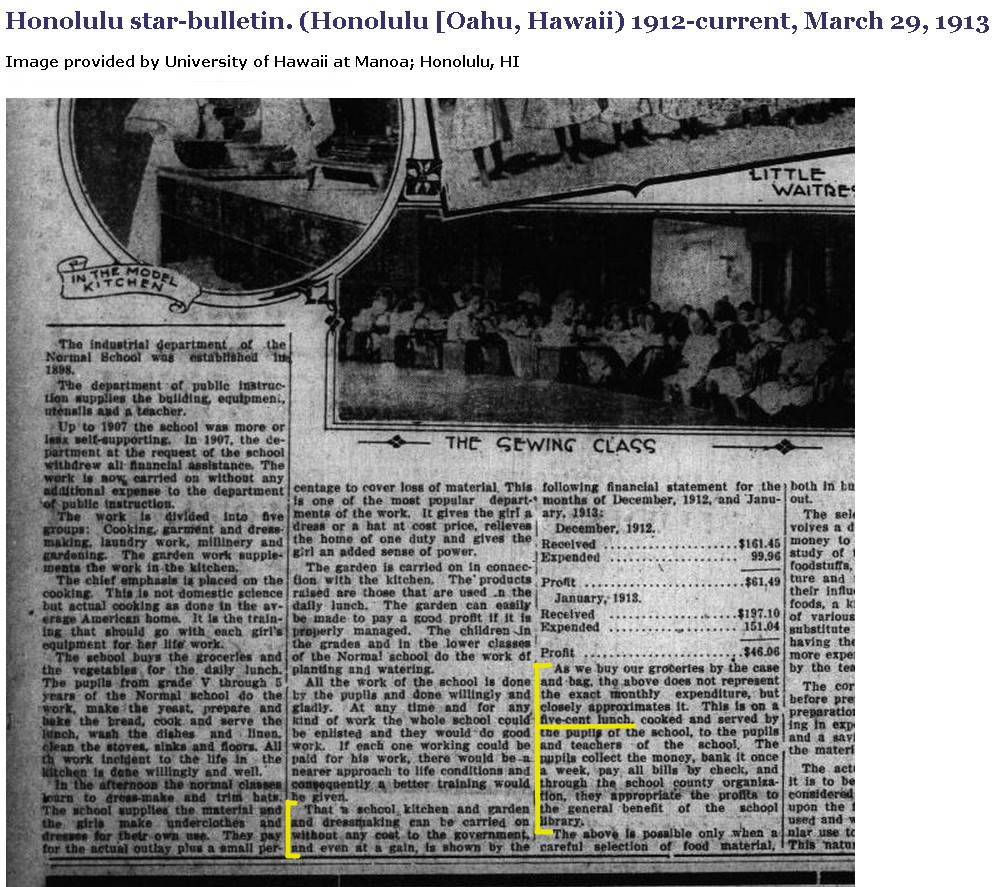
A December 6, 1921 article from The Maui News uncovers a previously undocumented fact about the Hawaii lunch tokens: Reduction in lunch price that changed the wording on the lunch tokens of Hawai’i.
This fact now provides evidence in the change of wording that is prevalent with the Hawai’i lunch token series. The two wordings are:
Base on this newspaper article, a single served lunch was originally priced at 5 cents for years. As the school lunch program were fully funded (by the local community), the school dropped prices (and switched to sell by entrée format) as they were a not-for-profit business entity. There are several articles in which the school asks for donations from the local community. In addition, for the students who could afford it, a 10 cent meal was available (four 2.5¢ entrées as a meal).
Wailuku School 2TL-123 and 2TL-124 are prime examples of this drop in price and change in wording on the tokens.
It can be said that:

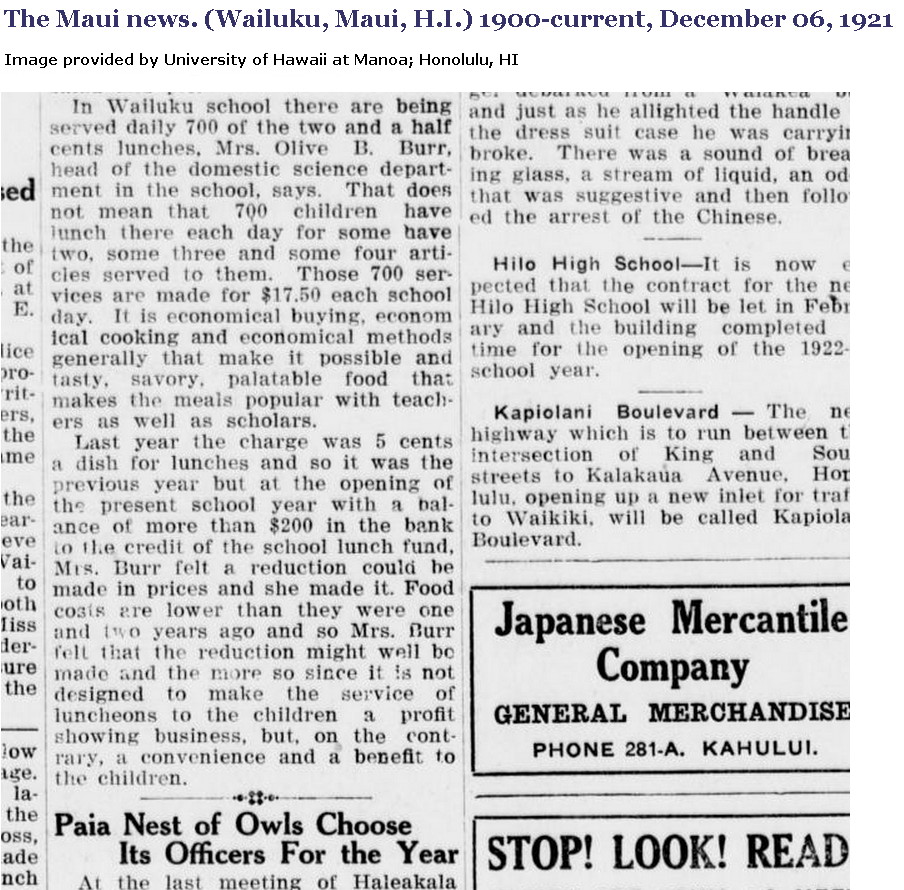
It was requested that I start to investigate and uncover more information about the lunch tokens of Hawai’i. After a few clicks this is my first find, a 1919 news article from The Maui News (Wailuki, Maui, T.H.) about the free lunch school program on the island of Kauai.
The Kapaa School (Kauai) is mentioned and the price of lunch was 5 cents. The school, price, and location correlates with M&R 2TL-49, 2TL-50, 2TL-50a, and 2TL-50b. The 1919 year is just a date of when the free lunch program was documented as being active and not when the tokens were being used, but it provides a good start.
The article is in the left column (click to enlarge).

Congratulations are in order for Garry Moore who took first place with two of his exhibits at the recent The Money Show of the Southwest:
I saw a brief write-up from a Coin World email of the recent sentencing of Bernard von NotHaus (Royal Hawaiian Mint co-founder and minter). With further interest I found a longer article (editorial) put out by The New York Sun.
http://www.nysun.com/editorials/beyond-bernard-von-nothaus/88958/
The original Coin World write-up:
http://www.coinworld.com/news/judge-sentences-liberty-dollar-founder-to-probation.html
 The Hawaiiana Numismatist ™
You must be logged in to post a comment.