Part 3: Lunch Tokens of Hawai’i (The Impetus)

The impetus behind the creation of the lunch school tokens was the rapid malnutrition of the children attending school in the Territory of Hawaii (early 1910s). Department of Health eventually cut funding to feed the malnutrition students. Civic groups stepped in when they could, but was only localized to a specific school and grade level(s). Teachers and other community leaders saw that a well fed student was a student that could learn at his/her full potential.  Many of the students were identified as not eating breakfast and/or not bringing a lunch. In some cases, the students would seek unhealthy food from food vendor carts that came  to the school.

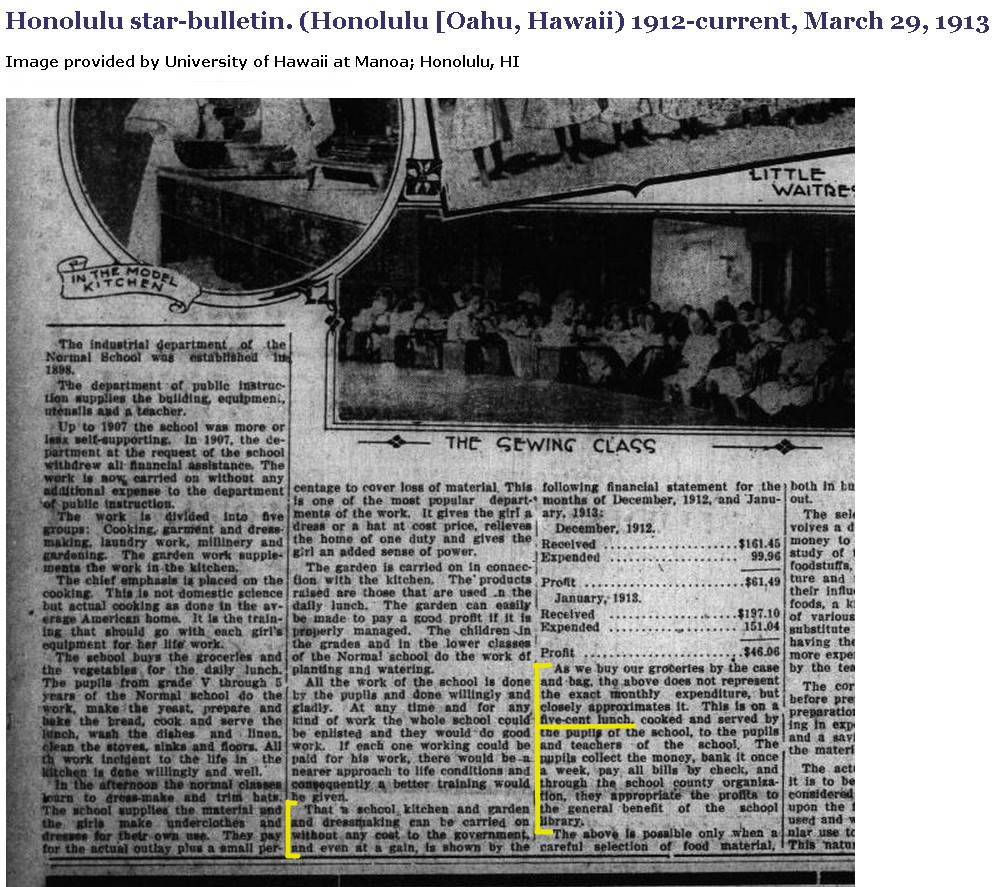
The students who could not afford lunch suffered the most. However, a self-sustaining lunch program was being developed at two schools in 1913. The Normal School was the model. The Normal School set the standard in which lunches were provided to students. A school kitchen was installed. Girls would be taught classes in cooking. Classes would be taught in gardening. Students (under training) created the meals. In fact, the school was showing a profit from its 5 cents a meal lunch program. Several dignitaries visited the school based on this program. Most of the schools began requesting kitchen equipment to aid in the malnutrition problem (and to keep the students  with no home provided lunches on school grounds). Based on the school’s curriculum, the cooking classes and gardening classes provided the mechanism to provide meals.

As for the school lunch tokens, think of its start as a welfare program instituted by the school for identified students with malnutrition. As a self-sustaining school lunch program arose, those who can pay paid with legal tender. Those who were identified as students with malnutrition where provided free lunch tokens (and most likely performed a school task in exchange for the token, such as cleaning).

As the lunch program grew, the lunch tokens were sold to the students at the beginning of the month. This was mostly likely to obtain funds in advance to pay for the food supplies for the oncoming month. But again, the underlying reason for the inception of the school lunch program is that it provided the means to aid low-income students to be fed by providing free school lunch tokens for meals.
normal

Part 2: Lunch Tokens of Hawai’i and its 5 Cent Value

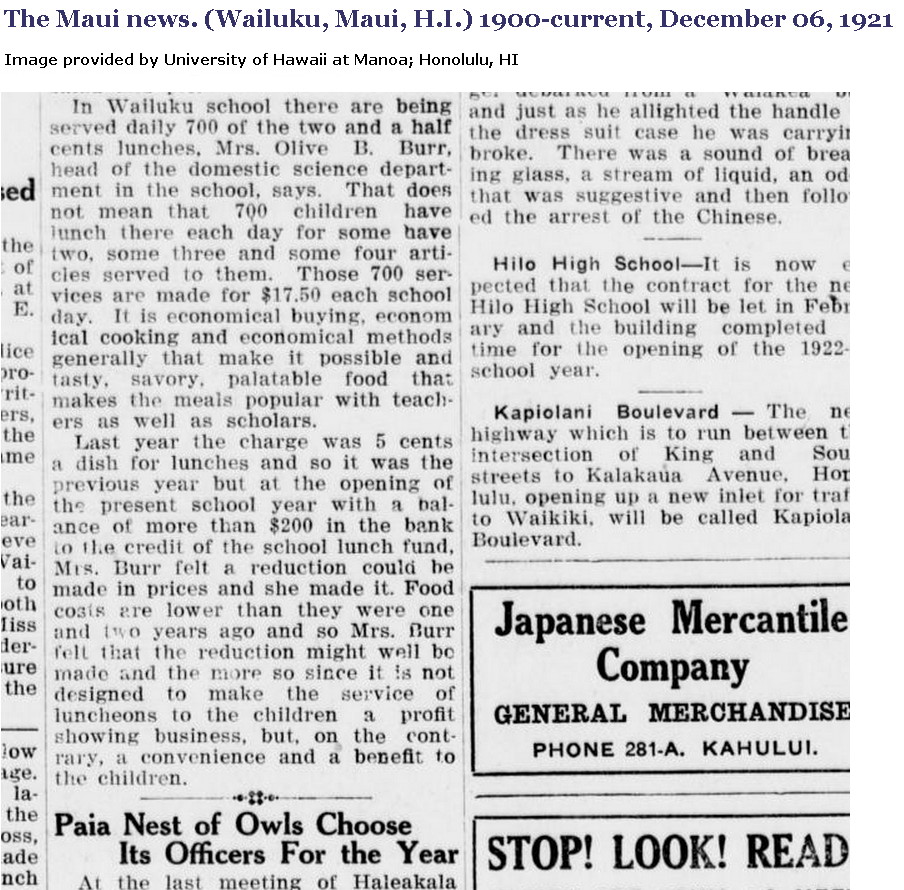
A December 6, 1921  article from The Maui News uncovers a previously undocumented fact about the Hawaii lunch tokens: Reduction in lunch price that changed the wording on the lunch tokens of Hawai’i.

This fact now provides evidence in the change of wording that is prevalent with the Hawai’i lunch token series. The two wordings are:

  1. Good for one 5¢ lunch (meaning: purchases a single meal whose entrées are selected by the cafeteria)
  2. Cafeteria 5¢ (meaning: purchases two  2.5¢ entrées as selected by the student)

Base on this newspaper article, a single served lunch was originally priced at 5 cents for years. As the school lunch program were fully funded (by the local community), the school dropped prices (and switched to sell by entrée format)  as they were a not-for-profit business entity. There are several articles in which the school asks for donations from the local community. In addition, for the students who could afford it,  a 10 cent meal was available (four  2.5¢ entrées as a meal).

Wailuku School 2TL-123 and 2TL-124 are prime examples of this drop in price and change in wording on the tokens.

It can be said that:

  • 2TL-124 (GOOD FOR ONE 5¢LUNCH) was used prior to December 1921 (single meal with entrées selected by the cafeteria)
  • 2TL-123 (CAFETERIA GOOD FOR 5¢) was used after December 1921 (single meal with two 2.5¢ entrées selected by the student)

wai1wai2

Part 1: Lunch Tokens of Hawai’i (Kapaa School, Kauai)

It was requested that I start to investigate and uncover more information about the lunch tokens of Hawai’i. After a few clicks this is my first find, a 1919 news article from The Maui News (Wailuki, Maui, T.H.) about the free lunch school program on the island of Kauai.

The Kapaa School (Kauai) is mentioned and the price of lunch was 5 cents. The school, price, and location correlates with M&R 2TL-49,  2TL-50, 2TL-50a, and 2TL-50b. The 1919 year is just a date of when the free lunch program was documented as being active and not when the tokens were being used, but it provides a good start.

The article is in the left column (click to enlarge).

kappa

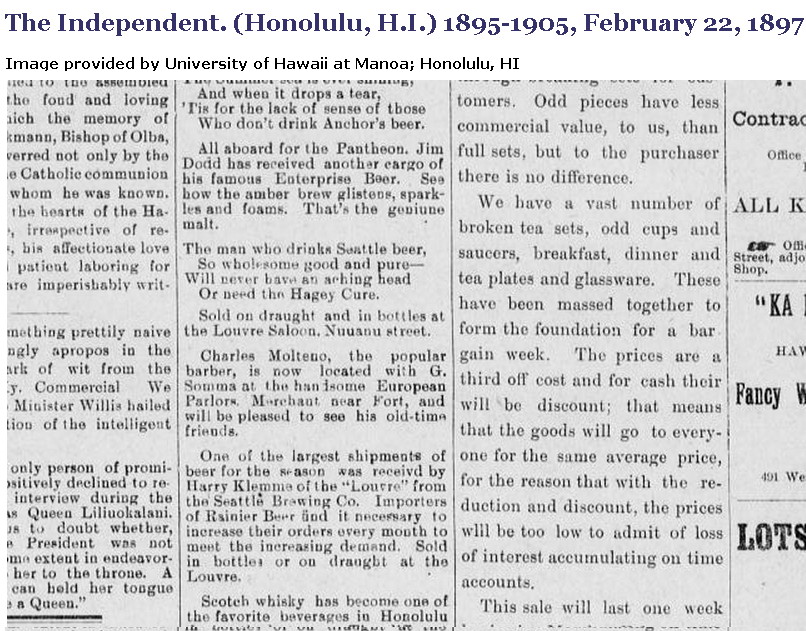
Saloon Token: James Dodd and Enterprise Brewing Company

1895 Pantheon Saloon Honolulu Token

Medcalf & Russell  2TS-21. I’m still trying to pin point the date of this token I believe I have done so. I place it in use in 1893.

On my previous blogs I identified the start year of the Pantheon Saloon as 1881.

Attached are news clipping from the University of Hawaii at Manoa (nice trip to Hawaii, in thought, not body).

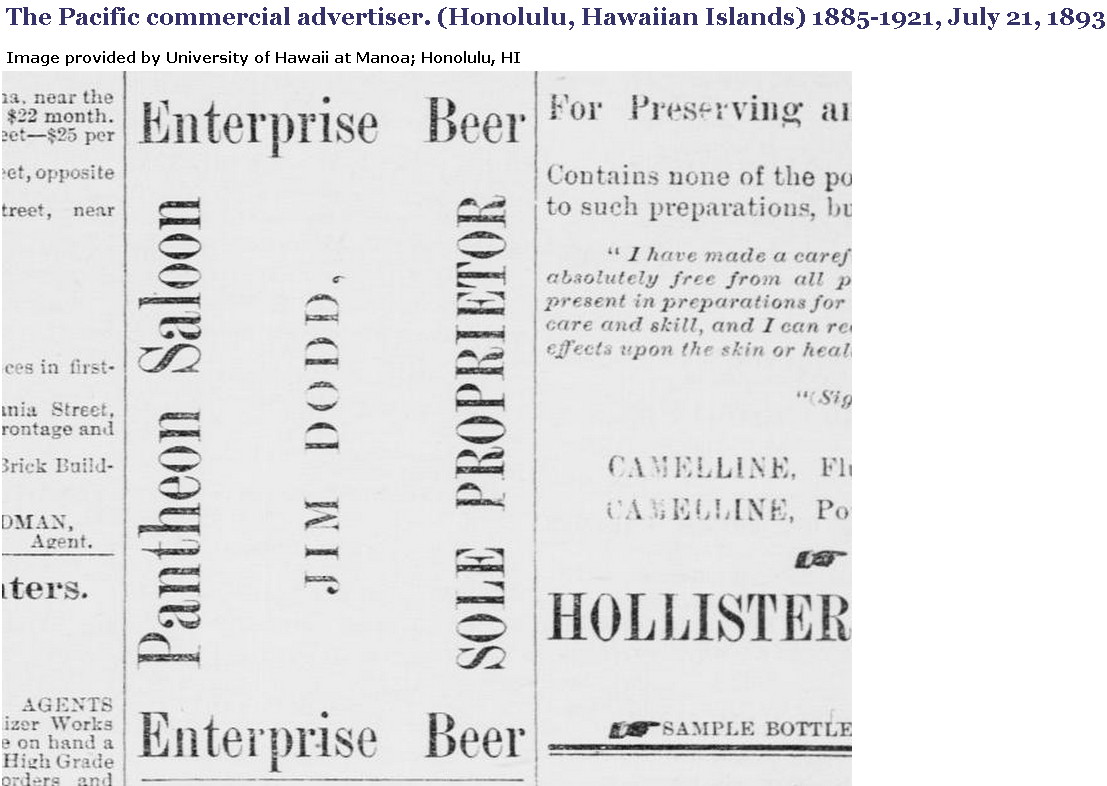
As you can see in the image below July 21, 1893 ad ties in three elements:  James Dodd, Pantheon Saloon, and Enterprise Beer.

beer1

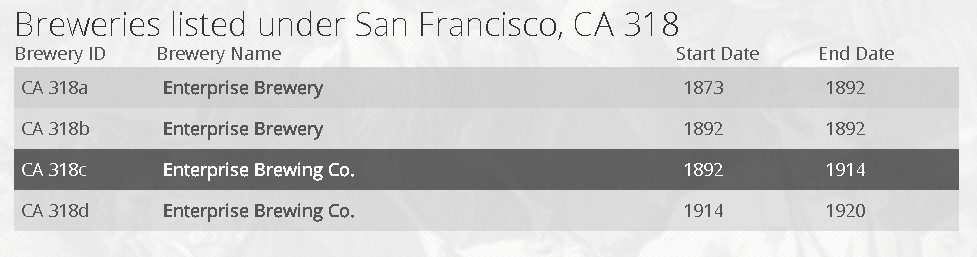
Brewer collectors have assigned the CA 318 identifier to brand name “Enterprise Beer”. The years align with the 1893 date from the news clipping above.

beer2

2TS-21  identifies the token makers as C.A. Klinkner & Co. S.F. Which  stands for Charles Alexander Klinkner of San Francisco. (Still researching this individual along with his company).

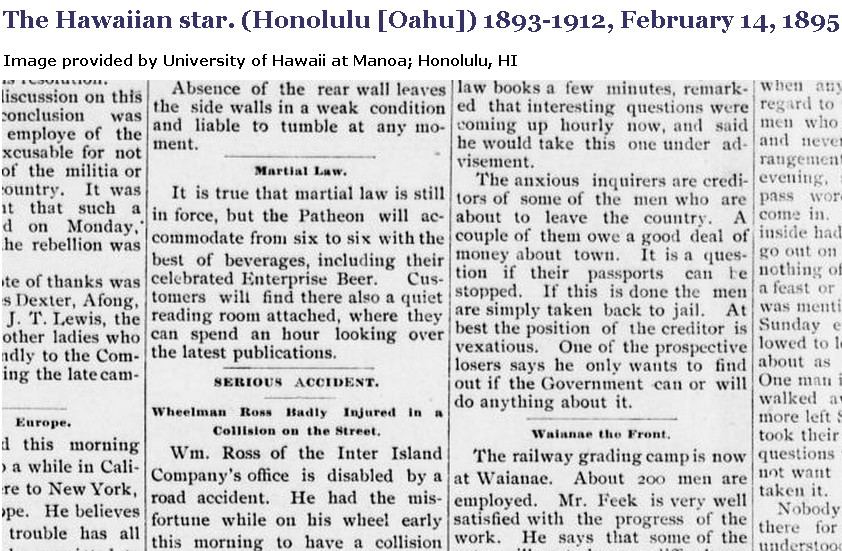
Below is an 1895 newspaper clipping  (I see it as funny as martial law declared, but you can still visit the Pantheon).

beer3

Then in 1897, Mr. Dodd still was selling Enterprise Beer. However, if you read further, Scotch whisky became more popular.

beer4

Then in 1898, Bock beer from Enterprise Brewing Co just arrived at the Pantheon.

beer5

“Working Samples” Maui Coin Club & Hawaii Coin Club [sic]

I was reviewing the two letters of provenance that was provided to me by Pressed Metal Products.  I purchased a total of 20 “working sample”  medals from their in-house archive earlier in 2014 (search my blog for the term “Maui Coin Club”).

These medal are not regular issue. They were struck with the original order and kept in the in-house archive of Pressed Metal Products. These are rather unique medals and definitely one of a kind Hawaiiana collectables (even more valuable with the letters of provenance from Pressed Metal Products, the original designer and minter of these medals).

Here are online “working samples” from Pressed Metal Products.

http://www.pressedmetal.ca/numismatists14.html

http://www.pressedmetal.ca/numismatists11.html

http://www.pressedmetal.ca/numismatists15.html

These working samples were also used to allow potential customers to see the previous completed medals that were design and struck by the by the company.

The point of this blog entry is to point out an error in one of the letter of provenance and reveal new information to the public.

  1. The term Hawaii Coin Club is mistakenly used to identify Hawaii State Numismatic Association (HSNA) in the letter of provenance. What this means is that I have in my collection 6 medals that were created and designed for HSNA by Pressed Metal Products. From an investigative  perspective, several of the HSNA medals were produced by  Pressed Metal Products. This fact is not mentioned in the 1991 Medcalf & Russell book.  The minting characteristics between the Maui Coin Club and HSNA medals are similar.
  2. I purchased the medals as excess inventory from the in-house archive of Pressed Metal Products. This was a chance of a lifetime to acquire these medals. No one else can lay claim (and provide written evidence) that they have original working samples of Maui Coin Club and HSNA medals.Maui Coin Club is no longer an active organization to acquire these medals. HSNA was not provided the opportunity to acquire these medals.
  3.  I obtained a working sample 2M-276 from  Pressed Metal Products. This confirms that 2M-276 was a designed and struck by Pressed Metal Products. This fact is not mentioned in the 1991 Medcalf & Russell book.

I prefer not to provide images of the letters of provenance at this time. Also, I have kept all email communications and letters/packages of the transactions. This provides further evidence of the authenticity of these 20 working sample medals.


NGC Registry: Updated My Hawaii Statehood Medal Design Type Set

I noticed that someone had quoted my NGC Registry custom set with their eBay auction listing for a Hawaii Statehood medal. Since its is being somewhat acknowledged as a numismatic reference (which I gladly appreciate) I decided to review and update my custom set.

Of particular interest for this  custom set update are:

(1) The addition of three references

(2) Update to the Type 2- The Heraldic Art Company Medal Design for:

a. Identification of previously undocumented 2M-5 variety that is  unlisted in Medcalf & Russell. 180 degree rotated die with thick planchet

b. Identification of previously undocumented 2M-4 varieties that are unlisted in Medcalf & Russell. Low and high volcano placement on thin planchet.

c. Identification of previously undocumented 2M-5 variety that is unlisted in Medcalf & Russell.  High volcano placement on thick planchet. (A request has been made to locate a low volcano on thick planchet to prove/disprove my low/high volcano thesis)

d. Identification of previously undocumented 2M-6 (gold) variety that is unlisted in Medcalf & Russell. Gold issue is only available with low volcano variety.

Here is the link for this NGC Registry custom set:

https://coins.www.collectors-society.com/wcm/CoinCustomSetView.aspx?s=9345

All the updates were previously documented in my blog. The image below is the low vs high volcano variety. My thesis is that the Low variety dies were first used, then the High volcano dies were used. Gold issue reflects low volcano (early strike). Thin issue has both the low and high volcano. Thick issue is currently seen with only high volcano.

All information discussed here (with the exception of the 180 degree rotate die)  is the result of my original research findings.

really